City Hunter (1993) review-a big creative swing and miss

While some could accuse Jackie Chan of playing the same kind of guy over and over, he’s at least tried to shed that skin in his later career.

Outside of portraying a Chinese revolutionary in the historic drama 1911 (2011), Chan channeled his inner Liam Neeson in The Foreigner (2017), showcasing his dramatic chops as a mourning father looking to avenge his daughter’s murder at the hands of IRA terrorists.

Even though critical reception for both projects was mixed, it showed that Chan was willing to use his cachet as an international superstar to stretch his acting range, rather than stick to his usual screen persona (a goofy, wholesome guy who loves martial arts).

One could argue that he chose these later roles out of necessity. After all, a 60-ish-year-old Chan simply couldn’t replicate the pure athleticism and intricate physical comedy that made him a household name in the first place.

But it should be noted that Chan has tried to mix things up before, with Wong Jin’s City Hunter (1993) being a noticeable mid-career experiment.

Instead of deploying his usual boyish charm, Chan is a considerably meaner in this film, playing a character who lustfully chases after women and dishes out violence in a very cavalier fashion.

Plus, the general tone of the film is a major departure from Chan’s previous work, where the comedy is much more Looney Tunes than his preferred Buster Keaton stylings.

Unfortunately, these changes don’t play to Chan’s strengths at all, and the general filmmaking on display isn’t strong enough to compensate for the movie’s many shortcomings.

As a result, all you’re left with is a really off-putting experience, where Chan and the filmmakers seem like they are actively trying to alienate the audience for 100 minutes straight.

In terms of plot, City Hunter follows the basic premise of the serialized manga of the same name (created by Tsukasa Hojo). Chan stars as a private detective who solves crimes alongside his assistant Kaori, who is the sister of his deceased partner. 

After being hired to locate a media mogul’s missing daughter, the pair’s search leads them aboard a cruise ship that is quickly taken over by armed thugs. Wacky hijinks ensue from there, as a colourful cast of characters help Chan take back the ship from the gunmen.
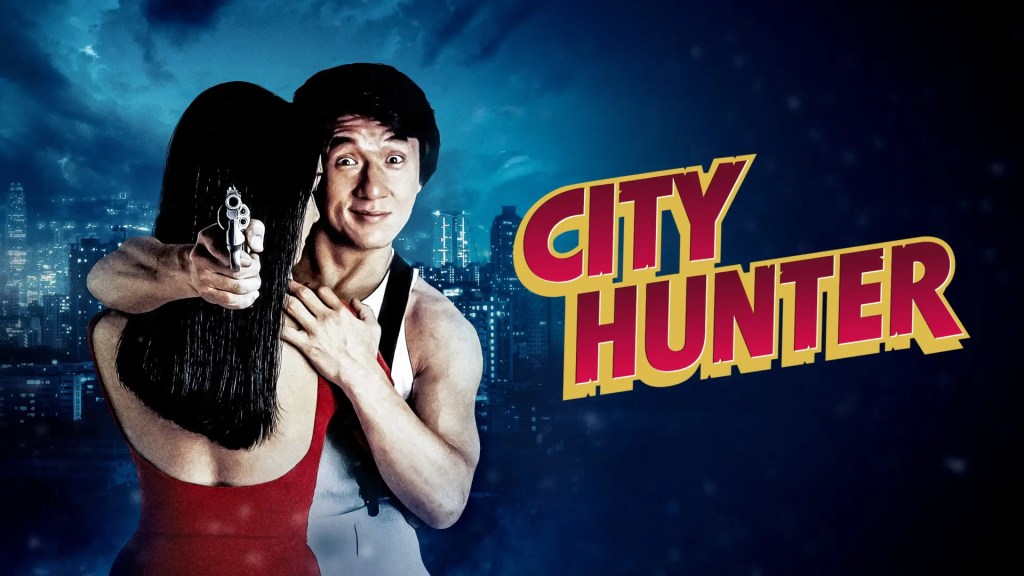
Despite its many flaws, City Hunter has the decency to show you what kind of movie it is right out of the gate.

Within the first three minutes or so, the audience is hit with garish mugging from the actors, cartoon sound effects deployed to heighten jokes, and a pungent pervy tone that wafts right through the screen.

It definitely sets the stage for a film that’s consistently obnoxious and even downright depraved at times.  

The one element that really soured me before the movie even got out of its starting blocks was the relationship between Chan’s private detective and his young assistant.

During the opening scene, City Hunter promises to take care of his dying partner’s 10-year-old sister and swears that he will “never seduce her.” Cut to the next scene where Kaori transitions from being a child to a beautiful woman (played by Joey Wang) in a single, continuous shot, with Chan’s character loudly proclaiming to the camera that such a development is “not fair.”

It would be one thing if this grooming joke was a one off, but the will-they-won’t-they relationship between City Hunter and his adoptive daughter is a romantic thread that’s woven throughout the entire movie.

Basically, Kaori’s whole deal is she’s constantly vying for her adoptive brother/father’s affection, and gets extremely jealous whenever he chases after other women (which is every five minutes or so).

While this back-and-forth is largely played for laughs, the filmmakers never at any point acknowledge that the idea of these two getting together is gross, which is a dark cloud that hangs over the entire picture.
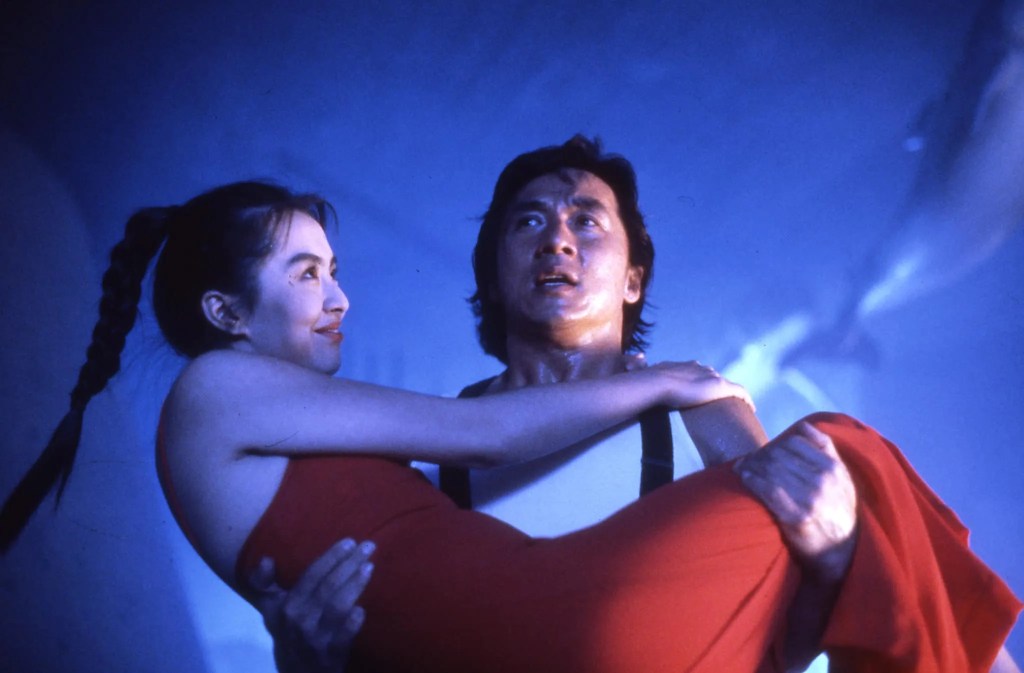
To make matters worse, City Hunter doesn’t really offer up enough exciting action set pieces to offset its busted moral compass.

For most of the movie, any fight scenes that break out are criminally short. Chan and his stunt team never get the chance to build up any momentum before the filmmakers seemingly get bored and switch back to some juvenile comedy skit.

And any fight scene that IS given enough room to breathe is pretty uninspired, where Chan is relying on editing tricks (rather than his raw physicality) to wow the viewer.

This includes a sequence where Chan is chased by a gang of skateboard punks, and it’s pretty obvious that his most impressive moves are being performed by a double. Apparently, stand-ins were used for this scene because Chan suffered a serious ankle injury, which should have been a sign from the Gods that this silly sequence should have been cut altogether.

What could be more galling than a Jackie Chan movie where he doesn’t do all his own stunts? How about a pointless musical number performed by actors who aren’t even in the main cast? Yeah, sure. Why not? Here’s three minutes of that.

Things looked like they were headed in the right direction with the introduction of Gary Daniels as the villain’s main henchman. On paper, Daniels is a great opponent for Chan, given his sharp look and athletic acumen as a competitive martial artist in real life. But when the two finally get together for a big brawl, it turns out to be a giant farce.

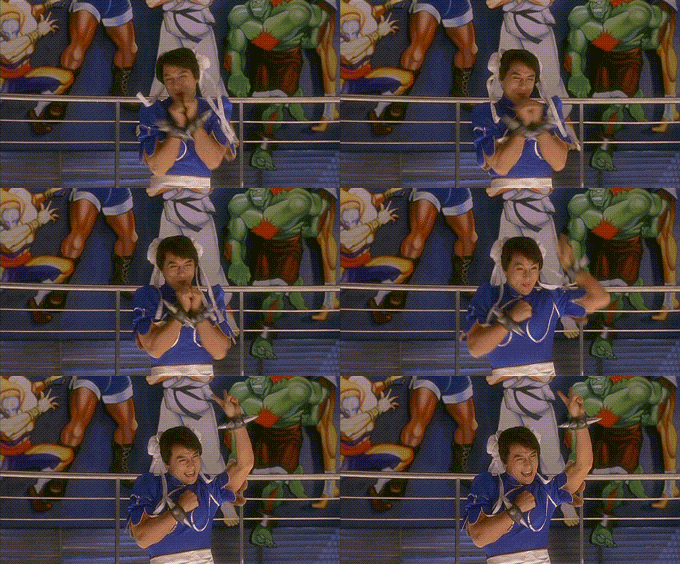
Instead of a traditional one-on-one bout, the scene morphs into a deranged video game pastiche, where Daniels and Chan (who is hallucinating) dress up like Street Fighter characters for some reason.

I will commend the filmmakers for committing to the bit, since they went to the effort of using the official music and sound effects from the game, alongside decent replications of the costumes and signature moves of each character. This moment is so surreal that it’s gone on to become more famous than the movie itself, with thousands watching it on YouTube not even knowing it’s connected to City Hunter.

But in the context of the full movie, this scene is staggeringly divorced from the ongoing plot, and it completely wastes a performer like Daniels on some self-indulgent cosplay (or a blatant paid advertisement courtesy of Capcom).  

It isn’t until the movie’s final reel that City Hunter provides a decent showcase of Chan’s abilities without any annoying interruptions.

In this climactic clash with Richard Norton (another real-life martial artist turned actor), the action and comedy is woven together far more naturally, and it at least looks like Chan isn’t hiding behind a bunch of smoke and mirrors to trick the audience (even though a double was reportedly used for Chan here to help save time on production).  

Regretfully, this fun action sequence comes far too late in the film to salvage all the bullshit that came before it.

Said bullshit includes an earsplitting soundtrack, which sounds like it was composed by a cat operating a single Casio keyboard with faulty wiring. When this movie doesn’t sound like a cheap carnival act, the filmmakers pipe in some cheesy guitar licks to try and make Chan’s character into some kind of discount James Bond. It’s all very obnoxious.

The supporting cast (which can often be the saving grace of an overwise middling film) is also severely underutilized, with most of these side players not getting nearly enough screen time to make a good impression.

Besides the one-note villains, the best example of this phenomenon is when actor Leon Lai is introduced as a gambler on the cruise ship who throws playing cards like ninja shuriken. After that stellar introduction, Lai is featured in maybe two other scenes before he’s completely forgotten about, exiting the movie having never interacted with Chan in any capacity.

The only actor who escapes this project with any kind of dignity is 90s Hong Kong bombshell Chingmy Yau, who plays an undercover cop tasked with taking down the bad guys alongside Chan. Unlike all the other women in the film, Yau’s character is treated with some respect by the writers, since she’s allowed to be sexy, funny, and a competent ass kicker all at the same time. This comes to a head in the film’s finale, when Yau and Chan take out a legion of goons by engaging in a dance that combines impressive acrobatics with deadeye marksmanship.

However, these quality nuggets can’t distract from the crushing reality that Chan (the star of the film) is just not cut out for this kind of material.

While he is normally a master of combining action and comedy, his appeal as a performer has always involved stringing together daredevil stunts and action sequences where it seems like he’s seconds away from grievous injury or death.

Hardy any of that tactile quality is present in City Hunter, where any trace of a human element is usually hidden behind broad gags that wouldn’t be out of place in a Three Stooges short or Wile E. Coyote cartoon.
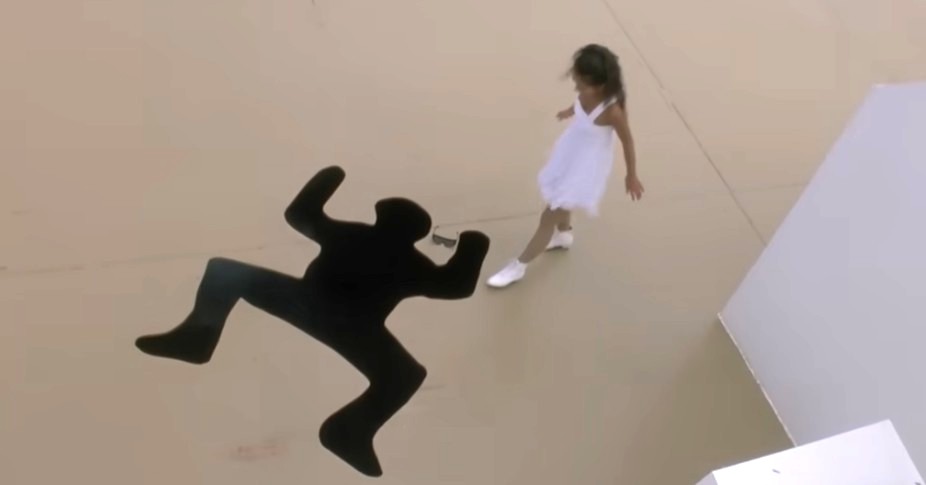
Plus, try as he might, Chan struggles to thread the needle playing a character who is an outright scoundrel and deviant.

His natural boyish charisma just doesn’t mesh well with scenes involving him drooling over attractive women and gleefully gunning down henchmen.

Maybe his performance was poisoned by my familiarity with his broader filmography, where he usually plays a morally upstanding hero who is sexually non-threatening.

But this role in City Hunter really called for a performer with more of an edge, backed by some writing that doesn’t solely trade in broad stereotypes.

Some may defend Chan’s exaggerated performance as being closer to the source material, but I don’t think that’s even true. Based on what I’ve seen from the broader City Hunter franchise (which is mostly the 1989 animated film subtitled .357 Magnum), the general tone is more of an even mix of comedy and serious drama. While City Hunter may act like a horny dufus a lot of the time, he’s at least shown to be intelligent and well-mannered when the situation calls for it.
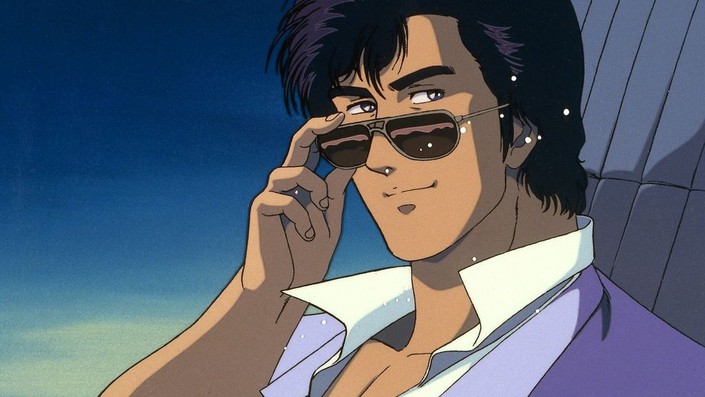
In the 1993 live action film, meanwhile, Chan’s version of the character is a total boob 100 per cent of the time, which is more of a creation of writer/director Wong Jing. And unfortunately, Chan wasn’t able to surpass such a bad creative vision, which is probably why he reverted back to his usual uncomplicated screen persona for the rest of the 1990s and 2000s.

Despite this career trajectory, his brief detour into moral depravity for 1993’s City Hunter remains a fascinating oddity in his career, since I don’t recall him playing a character like this ever again.

And hey, we should always celebrate actors (or artistic people of any stripe) when they decide to venture outside of their comfort zone, since it usually breeds creativity and gives the audience something new to chew on.

But here, Chan’s big creative swing just doesn’t really work on any level, unless you’re in that rare subset of people who always wanted to see him dress up like Chun-Li for some reason.

If you’re a member of that hyper-specific group, then this movie might just be a home run.
Verdict:

4/10

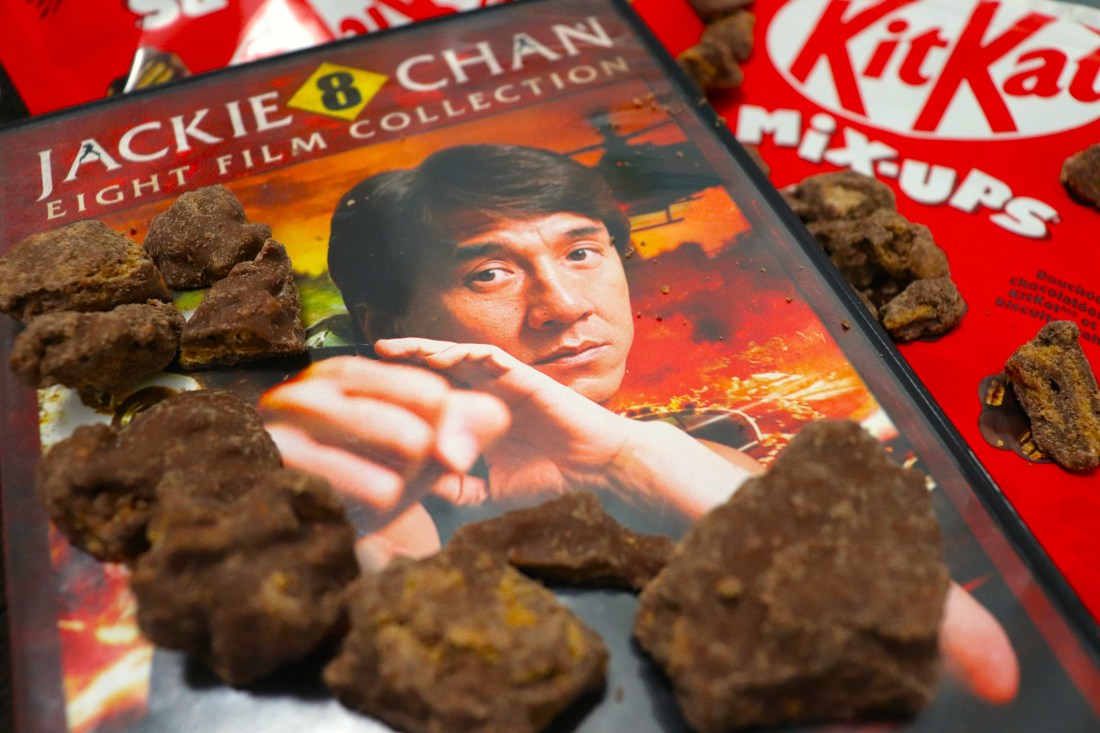
Corner store companion:

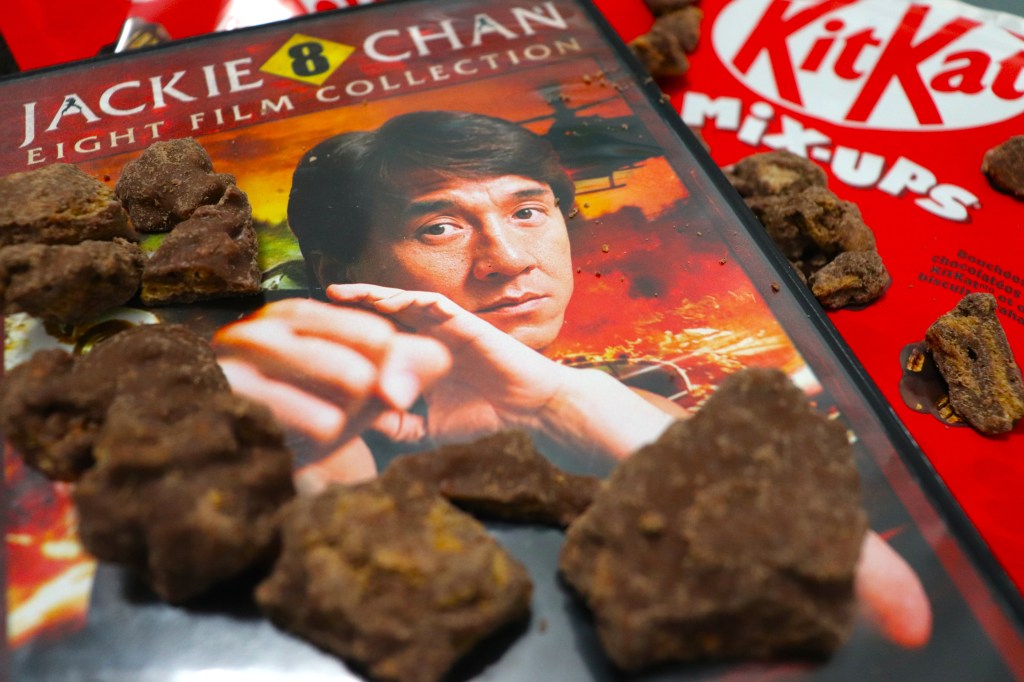
Kit Kat Mix-Ups (because this snack mixes chocolate and Graham Crackers far better than this film combines action and comedy)
Fun facts:

-Release date(s): January 14, 1993 (Hong Kong), March 20, 1993 (Japan)

-Box office: $14.6 million

– Tsukasa Hojo’s City Hunter manga was serialized in the pages of Weekly Shōnen Jump magazine between 1985 and 1991. The manga was quickly adapted into an anime series that produced 140 episodes (and several standalone animated movies) from 1987 to 1991.

-Outside of this 1993 film, the City Hunter manga has been adapted numerous times in live action, including Hong Kong’s Saviour of the Soul (1991), France’s Nicky Larson et le parfum de Cupidon (2018), and Netflix’s City Hunter (2022).  

-Internet film critic Movie Bob theorizes that actor Stephen Chow (Shaolin Soccer, Kung Fu Hustle) was originally slated to star in this adaptation of City Hunter given his close relationship with director Wong Jin at the time. However, I couldn’t find any other independent source to verify this claim.

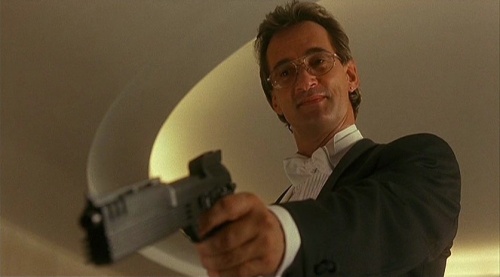
-Richard Norton’s firearm of choice in this film is the Auto 9, the same modified Beretta 93R wielded by Peter Weller in the Robocop series.
-A English dubbed version of this movie can be watched in its entirety on the Shout! Studios YouTube channel.

D.O.A. (1950) review-moderate buyer’s remorse

I’m a sucker for a compelling elevator pitch.

It’s a good thing I’m not one of the judges on Shark Tank or Dragon’s Den, because I could definitely see myself throwing all my money away based on the first 15 seconds of some greasy huckster’s presentation (and nothing else).

I’m the same way with a lot of movies. All it takes is an interesting hook or tagline and I’ll forgo any questions I have about the film’s production to slap down my hard-earned cash and watch it.

Enter Rudolph Maté’s D.O.A. (1950), a film that grabs you immediately by presenting a main character who must solve his own murder, having been fatally poisoned and given only a few days to live.

That description alone sold me, since it promises some of my favourite elements in a movie: mystery, suspense, a ticking clock … all that jazz.

Unfortunately, D.O.A. never really harnesses its full potential, with the protagonist’s status as a dead man walking coming across as a major afterthought.

This left me feeling like a real mark, almost like I was hoodwinked by whoever whipped up the original promotional material that promised a movie “as excitingly different as its title!”

In terms of more specific plot details, the story follows hard-working accountant Frank (Edmond O’Brien), who travels from his small town to San Francisco for a solo vacation.

After a night of partying with some strangers, Frank wakes up to discover he is sick, with doctors later confirming that he ingested a deadly poison with no known antidote.

Despite only having days to live, Frank is determined to find out who poisoned him and why, leading to a desperate chase that puts him in the path of some real sinister characters.

Outside of this alluring premise, the movie itself kicks off on a very compelling note.

Rather than tell the story in linear fashion, the film actually starts at the end, where we see a disheveled O’Brien enter a police station to report his impending demise.

This opening sequence does a great job of crafting suspense, with the camera aimed squarely at O’Brien’s back as he slowly makes his way through the world’s (seemingly) longest hallway. The bombastic score and lengthy camera shots do a great job of setting the tone for a gritty film noir, with a few mysterious lines of dialogue sprinkled in to hint at things to come.

The film then flashes back to a couple days earlier, which is where we start to run into some problems.

One of the movie’s most glaring flaws emerges when we meet Frank’s secretary Paula (Pamela Gibson), who is in love with her boss despite him not wanting a serious relationship.

This dynamic is meant to drive a lot of D.O.A.’s emotional stakes, effectively giving O’Brien’s character something to live for as the two grow closer throughout the course of the narrative.

But the major issue here is that the pair have no romantic chemistry. Most of the time, it seems like O’Brien is interacting with his annoying kid sister instead of someone he is falling deeply in love with.

So when the two characters confess their true feelings for each other in the third act, it comes across as forced and unnatural, with the movie’s string-laden score having to do a lot of the emotional heavy lifting.

A far bigger problem is how Maté and his screenwriters fail to capitalize such a compelling premise.

Even though the protagonist’s body is supposedly being ravaged by a deadly poison, this physical obstacle rarely (if ever) materializes on screen.

Sure, every now and then O’Brien will lightly grab his stomach like he’s experiencing a mild tummy ache, but that’s about it.

There’s no scene where O’Brien passes out from the pain of his illness, or encounters a major setback because he doesn’t have enough strength to run away from pursuing goons.

At certain points in the movie I would forget about the poisoning altogether until a character brought it up, which is a telltale sign of a messy screenplay.

It’s almost like the poisoning was completely absent from the first draft of the script, with that specific plot element being added into subsequent rewrites to clumsily up the ante.

The screenwriters do attempt to cover their tracks by having one of O’Brien’s doctors explain that he won’t feel the effects of the poison for a while before it comes on “suddenly.”

But this feels like a lazy way to justify why the film is so often filmed and paced like a standard drama, featuring lots of scenes of people talking in offices or hotel rooms with little sense of urgency behind them.  

This fumbling of the movie’s underlying premise is a real shame, since D.O.A. is an otherwise competently constructed film noir.

The cast is pretty solid across the board, even if the two leads fail to produce a single spark of on-screen sexual attraction.

One of the film’s standout performances actually belongs to character actor Neville Brand, whose manic energy as a psychotic henchman breathes a lot of life into the third act.  

The movie’s cinematography is a little muted compared to other film noir of the era, but it does have its moments. This includes an impressive sequence where O’Brien is running away after receiving his fatal prognosis, and the camera follows him from a moving vehicle as he bumps into pedestrians on a busy city street. The scene was apparently shot on the fly without any filming permits, which adds a lot of scrappy spectacle to the proceedings.

And the movie’s score does a pretty consistent job of propelling the action forward. It sounds like a contingent of brass and string instruments is constantly in pursuit of O’Brien as he desperately tries to stay one step ahead of the bad guys.

But despite all these impressive surface elements, I couldn’t help but feel like the film was missing something vital at its core.

The sheer unwillingness by the filmmakers to engage with the central premise remained a thorn in my side throughout most of the runtime, especially since I’ve seen this concept done far better in other movies.

Say what you will about the Crank duology (and how tasteless those films can get), but at least directors Mark Neveldine and Brian Taylor make you feel like you’re getting a lot of bang for your buck.

Throughout both entries, Jason Statham’s character spends virtually every second on screen visibly suffering through action movie shenanigans as his body gradually deteriorates.

This dynamic leads to a new outlandish sight gag, fight scene, or shootout every 10-15 minutes, creating a relentless pace that matches the kind of immediacy promised by the film’s synopsis.

D.O.A., meanwhile, kind of meanders for a lot of its runtime, with the premise’s propulsive potential mostly cast aside except for a few key scenes.

Having said that, I can see why this film is still held in such high regard by modern movie critics, since its story structure was considered pretty unconventional at the time of its release.

However, there’s a massive gap between theory and application that’s simply too hard to ignore, and all the movie’s good qualities can’t provide an adequate counterbalance.

Moving forward, I hope this experience helps me better manage my expectations in the future, as I’ve been known to get far too emotionally attached to what a movie COULD BE as opposed to what it ACTUALLY IS.

But when it comes to watching D.O.A., I still can’t help but feel at least a moderate case of buyer’s remorse, even if the used three-pack DVD I bought to watch it cost, like, two bucks with tax.

Verdict:

5/10

Corner store companion:

Quaker Caramel Chocolate Chip Rice Cakes (because it sounds like a good idea on paper, but the execution leaves a lot to be desired)

Fun facts:

–Release date(s): December 23, 1949 (premiere), April 21, 1950 (general release)

-In 2004, D.O.A. was selected for preservation in the U.S. National Film Registry for being “culturally, historically, or aesthetically significant.” It was added to the registry alongside films such as Ben-Hur (1959), Enter the Dragon (1973), Eraserhead (1977), Schindler’s List (1993), and Unforgiven (1993).

-Outside of the Crank movies, D.O.A. has been remade at least four other times in the years 1969 (as Color Me Dead), 1988, 2017, and 2022.

-Due to a filing error, the film’s copyright was not renewed in time and subsequently fell into the public domain. Because of this, the film can currently be watched in its entirety on YouTube.

Logan’s War: Bound by Honor (1998) review-one epic drop kick can’t save this movie

Writing about an actor or filmmaker’s work shortly after their death is always a dicey exercise.

On one hand, if the film is good, you can use it as a stepping stone to wax poetic on their entire career. I got that opportunity earlier this year through reviewing The Story of Us (1999), which I found to be quite enjoyable and emblematic of director Rob Reiner’s broader filmography.

However, if the movie is bad, you run the risk of coming across as a callous engagement farmer who is dancing on someone’s grave for clicks. This puts me in an awkward position having recently watched Logan’s War: Bound by Honor (1998), a made-for-TV movie starring recently deceased action star Chuck Norris.

Because the movie IS bad (no doubt about it), so how do I thread that needle without sounding like a brazen opportunist?

But I soon realized that even the most diehard Norris fans (I’m talking about the people who enjoy his work unironically, outside of all the internet memes), would probably admit that Logan’s War is not his best.  

It marks a time when Norris had all but given up his role as a theatrical leading man and he was more than willing to rest on his laurels as a mainstay of scripted CBS programming.

Plus, despite getting top billing, Norris barely appears in this movie and only dishes out his trademark martial arts ass whoopings in the last five minutes.

So, I think trashing Logan’s War is a pretty safe prospect, given that it barely registers as a Norris vehicle at all and just comes across as some cheap movie-of-the-week that’s meant to be played in the background at a West Texas retirement home.

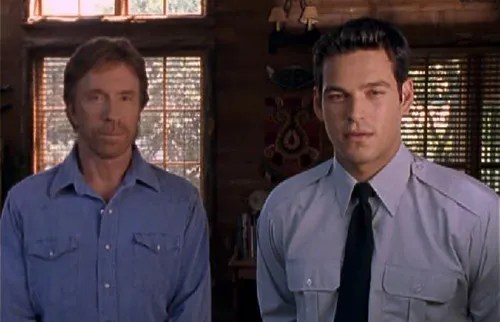
In terms of screentime, the real star of this film is the titular Logan (Eddie Cibrian), who’s orphaned as a young boy after his entire family is murdered by the mob.

After being taken in by his uncle Jake (Norris), Logan vows revenge and is trained in martial arts, eventually using these skills to become an Army Ranger.

But government-sanctioned bloodshed can only satisfy Logan for so long, and he eventually leaves the military to set his sights on finally killing mobsters who wronged him as a child.

From this synopsis, you’ve no doubt noticed that this movie covers a lot of ground, so much so that you’re probably wondering how the filmmakers elegantly squeeze all these story beats into a svelte 95-minute runtime.

Well, the short answer is: they don’t.

Instead, the movie just kind of arbitrarily switches genres every 30 minutes or so. It starts out as a coming-of-age story before transitioning into a military action film, leaving just enough room at the end for an urban revenge thriller to take over at the end.

This means that barely any time is dedicated to letting these disparate elements marinate, with all plot and character development flying by at lightning speed.

The cast member who suffers the most from this relentless pacing is Brendon Ryan Barrett, who plays Logan at 10 years old. Despite being saddled with some pretty heavy material (mourning the brutal murder of his parents and baby sister), Barrett manages to navigate these complex emotions with remarkable poise despite his age.

But just as we’re getting used to following this kid’s emotional journey, the film transitions to Cibrian as adult Logan, and all the groundwork that Barrett laid is thrown out the window.

It’s not that Cibrian is bad or anything, but the script basically doesn’t give him the opportunity to emote past the cool, stoic professionalism one normally associates with action heroes from the 1980s and 90s.  

As for Norris, he’s such a non-entity in this film that he might as well not be there.

While he’s definitely up to the task of leading a grizzled pep talk or patriotic training montage, he doesn’t have the acting chops to anchor all the scenes in between. He showcases maybe two or three different facial expressions throughout the entire film, and his voice rarely rises above a dull monotone.

And then, he disappears for a 30-minute stretch in the middle of the film, like he couldn’t even be bothered to star in his own movie.

As a result, Logan’s War comes across as low effort and half-baked most of the time, even for a TV movie from this decade.

Outside of all the cheap production tricks (stock sound effects, digital zooms, flat lighting, etc.), the film’s writers can’t even commit to their zanier ideas.

Early in the story, it’s revealed that Logan possesses a supernatural ability called a “proximity sense.” It’s essentially a bootleg “Spidey Sense” or a watered-down version of “the Shining,” where Logan receives a vision of the future that warns him of incoming danger.

Is introducing psychic superpowers into a grounded action drama incredibly dumb and creatively bankrupt? Sure. But at least this reveal caught my attention and made me wonder how they’re going to incorporate this element into the film’s myriad fight scenes.

Unfortunately, the scriptwriters (which includes Norris and his brother Aaron) either got bored of Logan’s “proximity sense” or just plain forgot about it, since it doesn’t factor into the last third the movie.

I’m just saying, Logan could have definitely used these superpowers in the film’s climax, where he takes on an entire mansion full of armed mobsters.

The only reason he doesn’t perish during this assault is thanks to a last-minute save from Norris, who shows up despite not knowing about his nephew’s plan ahead of time.

At the very least, this nonsensical plot development leads to the movie’s best (and funniest) moment, where a 58-year-old Norris takes out the main villain by drop kicking him through a car windshield.

Now, clips like this might give you the impression that the action choreography in Logan’s War is consistently crazy and off-the-wall. However, the reality is that most of the fight scenes are pretty bog standard and not that different from what you would find in an average episode of Walker, Texas Ranger.

Norris’ stunt team is obviously very talented, but there’s nothing really going on behind the camera to enhance all the punches, kicks, and grapples.

In fact, some of the production decisions actively take away from the action, such as the filmmakers’ annoying tendency to inject slow motion into a lot of the fight scenes.

This makes a lot of the action choreography appear slow and stagey, like the cast is performing a martial arts demo for a crowd at Six Flags.  

There are occasional flourishes of interesting action outside of Norris’ hilarious windshield kick, like when Cibrian takes out two mobsters by firing his Desert Eagle while hanging upside down in a broom closet.

But those moments are few and far between, which is a major problem when seeing Norris and his acolytes beat up bad guys is the only reason you’d watch one of these movies in the first place.

Instead, all you’re left with is something that looks and feels like an extended TV pilot that never got picked up for a full slate of episodes.

This kind of half-hearted approach to filmmaking is emblematic of the rest of Norris’ career.

Heading into the 21st century, he would eventually move away from full-time acting altogether, using his status as an elder statesman of cheesy action schlock to star in Polish bank commercials and book cameos as himself in other movies.

Today’s younger film fans will probably only recognize Norris as this parody version of himself, alongside his public opposition to gay marriage, signal boasting of Barack Obama birtherism conspiracy theories, and repeated endorsement of a country that’s currently committing a horrific genocide in the Middle East.

So while Logan’s War is a pretty forgettable film overall, it could be seen as a tipping point where Norris decided to just cash in on past glories and fully commit himself to bad politics.

That being said, his legacy hasn’t been etched in stone quite yet, since we’re only a couple months removed from his death at the age of 86.

And even though we won’t know what future generations will think of Norris’ career and public persona, I’m fairly certain that Logan’s War won’t be remembered fondly … outside of that climactic dropkick of course. That shit is evergreen.

Let’s watch it again, shall we …

Verdict:

4/10

Corner store companion:

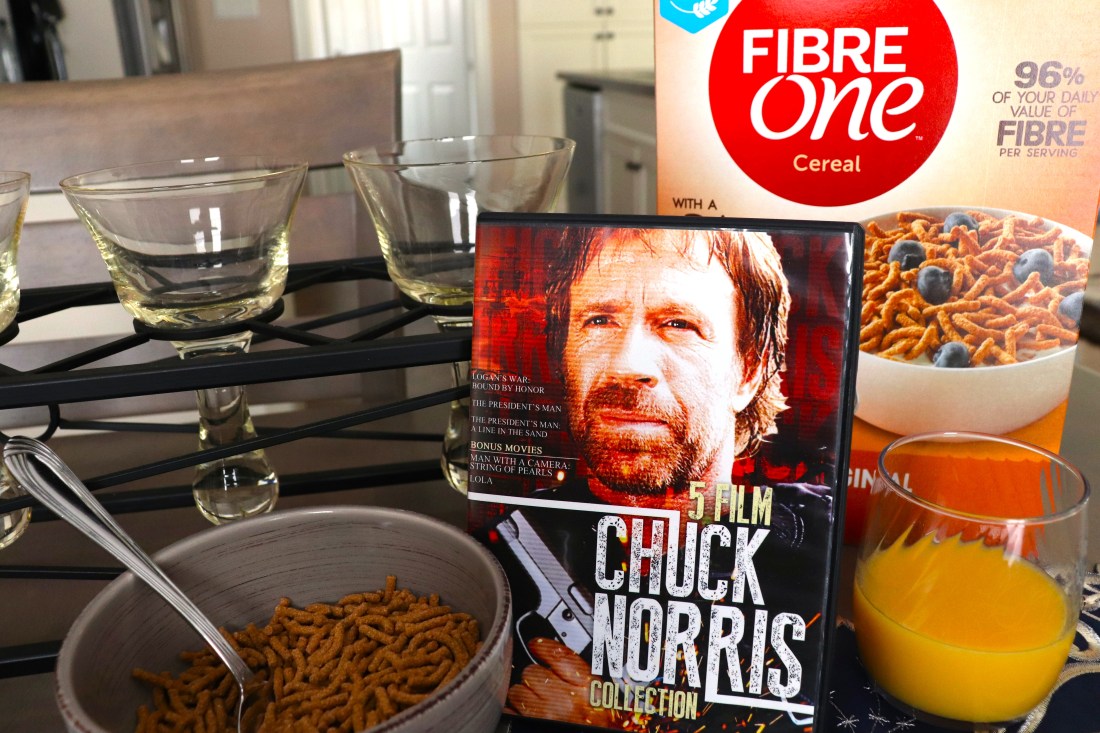
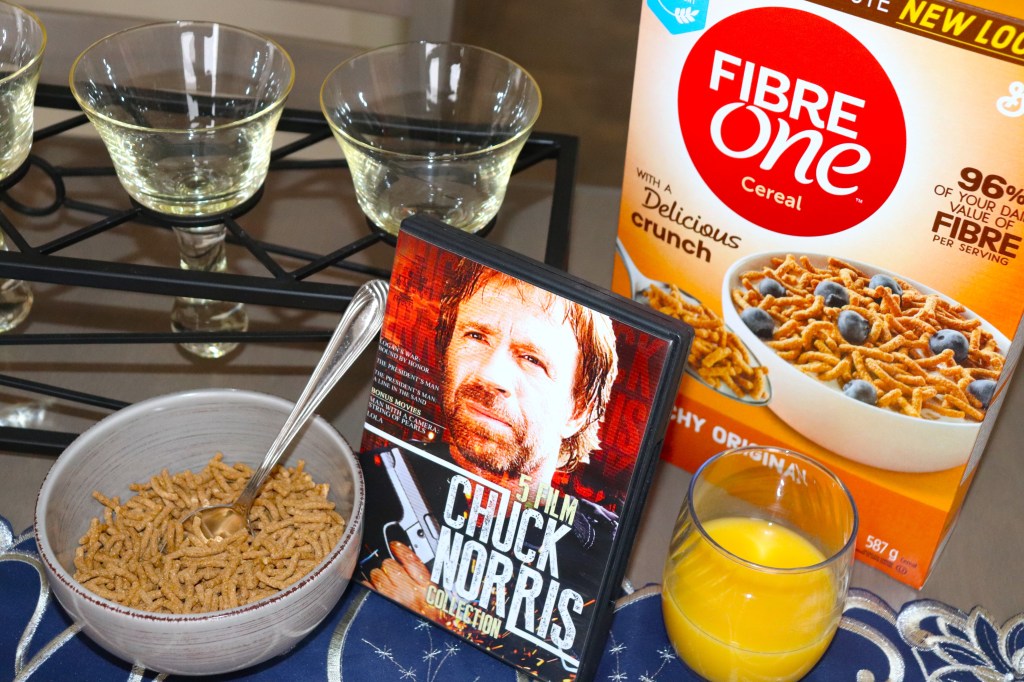
Fibre One Cereal (because if you’re watching a Chuck Norris film in 2026, chances are you need more fibre in your diet)

Fun facts:

-Air date: Nov. 1, 1998

-Logan’s War was created under Norris Brothers Entertainment, a production company run by Norris and his brother Aaron. NBE is also responsible for producing the later seasons of Walker, Texas Ranger and other TV movies starring Norris such as The President’s Man (2000).

-Norris will appear in at least one more film following his death in March. According to IMDB, he has a supporting role in the horror comedy Zombie Plane (starring Vanilla Ice), which is scheduled for a late 2026 release.

–Logan’s War: Bound by Honor can be watched in its entirety online through the official Samuel Goldwyn Films YouTube channel.
Albuquerque (1948) review-when the sidekick steals the show

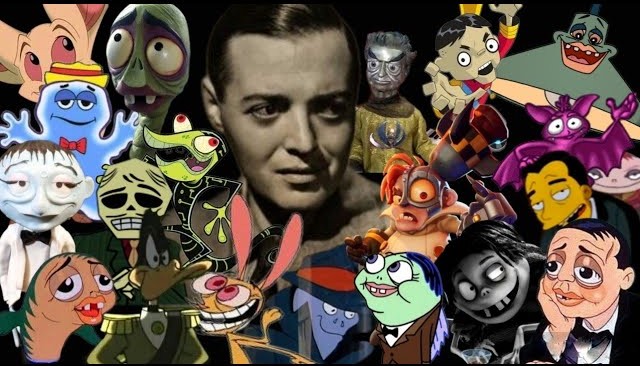
To me, watching older movies always had a joyous archeological quality to it. If you spend enough time checking out films from Hollywood’s Golden Age, for example, you might stumble upon a media artefact that influenced a lot of the pop culture you enjoyed growing up. For example, after discovering Walter Brennan in Sergeant York (1941) I remember thinking to myself, “Oh, so this is the guy all those voice actors have been imitating in my favourite cartoons.”

I experienced the same phenomenon with actors Peter Lorre in The Maltese Falcon (1941) and Charles Laughton in Mutiny on the Bounty (1935), since their likenesses were subsequently repackaged into a variety of animated shorts produced by multiple studios.

Peter Lorre and his many animated avatars

Peter Lorre and his many animated avatars over the years

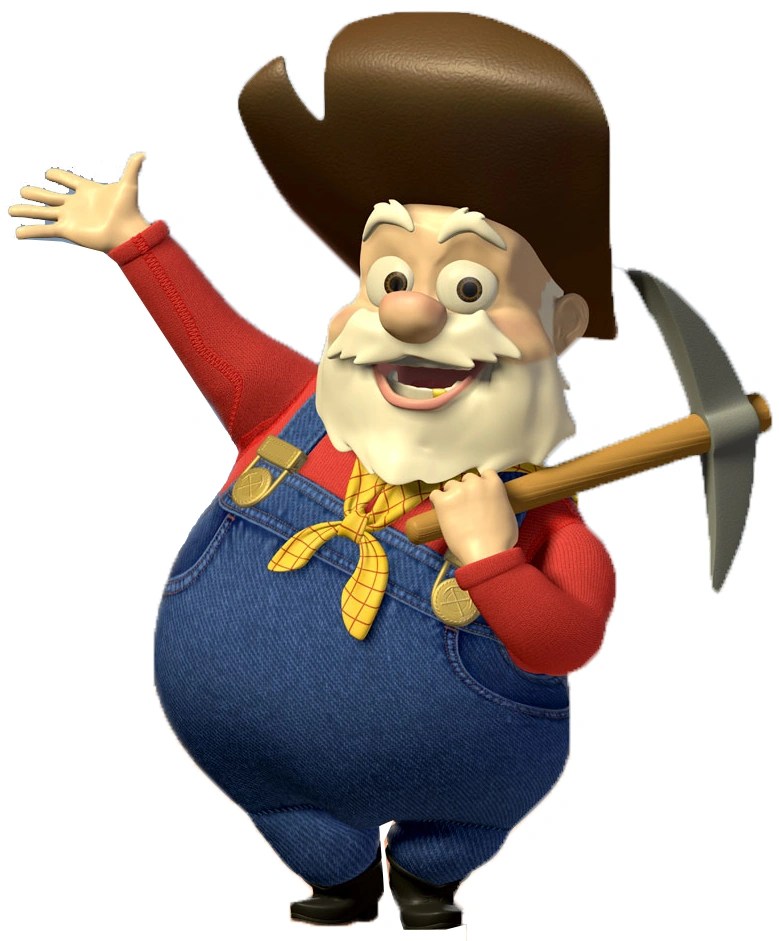
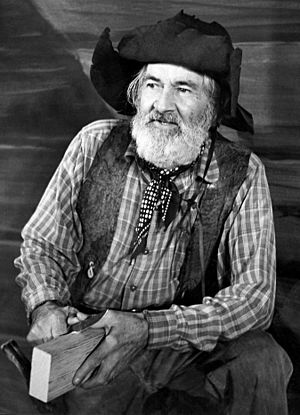
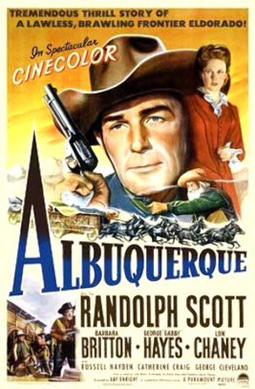
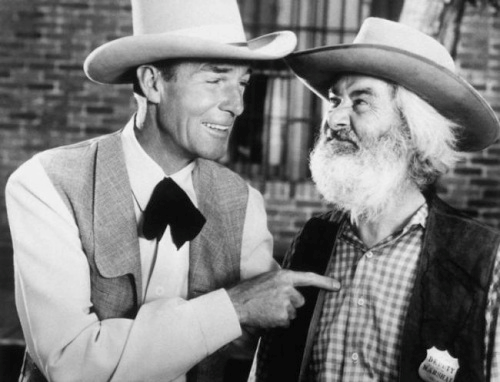
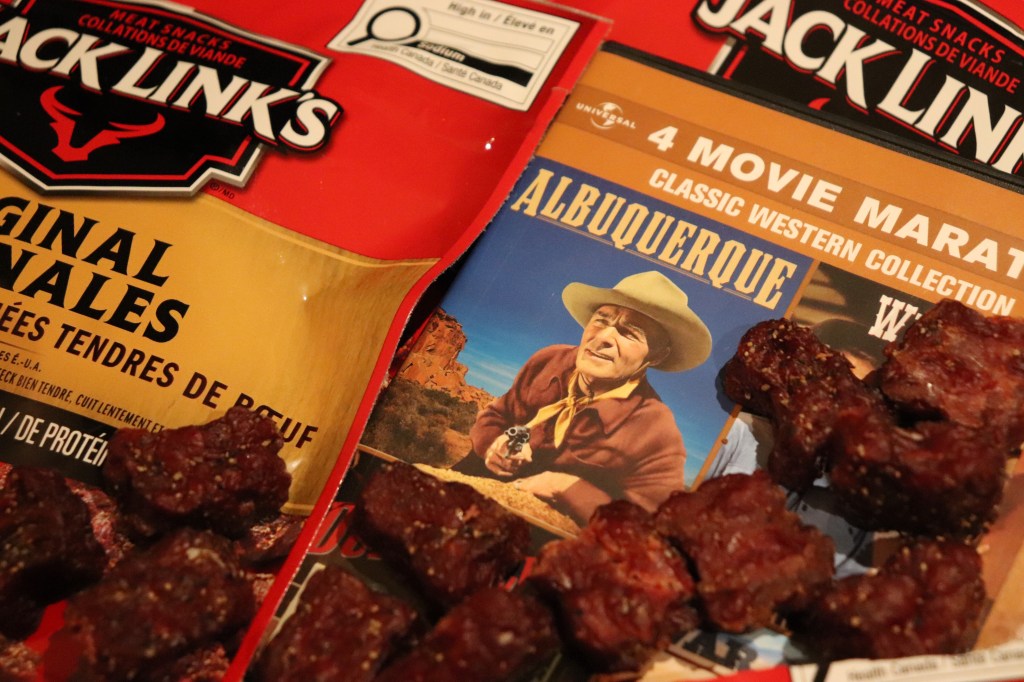
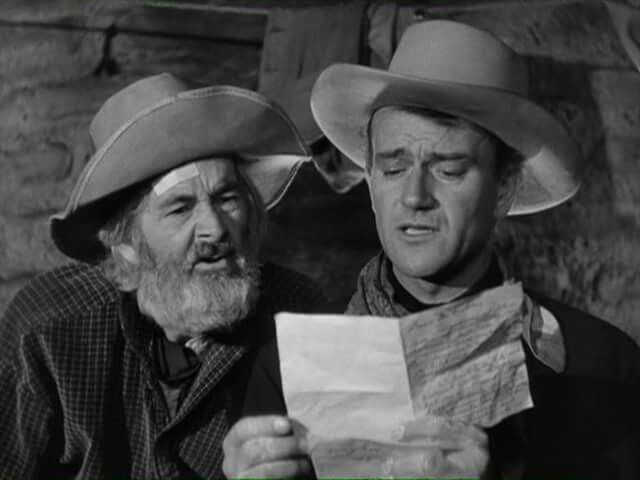
This sense of déjà vu struck me once again during a recent screening of Ray Enright’s Albuquerque (1948). Even though this film is a pretty standard western overall, actor George “Gabby” Hayes was immediately recognizable as an archetype that’s been imitated and homaged to death in properties such as Blazing Saddles (1974) and Toy Story 2 (1999).

Despite serving as the comedic sidekick to leading man Randolph Scott, Hayes’ old coot with a heart of gold easily steals the show, delivering some of the film’s best lines and breathing some life into a formula that was stock even for the time.

Thanks to Hayes (and other members of the supporting cast), Albuquerque is an entertaining enough watch for a lazy weekend afternoon, despite being weighed down by a generic look and feel that makes it hard to distinguish from other westerns of its era.

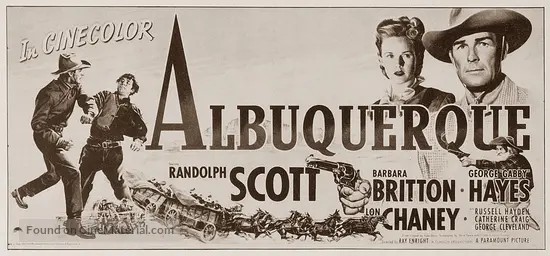
As mentioned before, the film stars Scott as Cole Armin, a former Texas Ranger who travels to Albuquerque to work for his uncle’s freight hauling business. After discovering that his uncle is far from a law-abiding businessman, Armin bands together with some locals to start a rival freight company and run the corrupt tycoon out of town. But Armin’s uncle doesn’t take kindly to this friendly competition, resulting in a gang war of sorts that gradually escalates over time.

Again, the story and characters featured in Albuquerque are pretty old hat, even by 1948 standards. The concept of a lone gunman riding into town and cleaning out its criminal element had already been done countless times before, and the filmmakers don’t even try to switch things up on an aesthetic level.  

The most obvious missed opportunity here is the New Mexico setting, which could have been used to highlight the state’s unique topography or its precarious status as a US territory in the 19th century.

Unfortunately, none of that comes to pass in the film itself.

The action could have been set in California, Utah, Nevada, or Texas judging by the standard set decoration and sparse landscape shots of non-descript deserts and canyons.

And lest you think any kind of geographic specificity is an unreasonable ask in a Golden Age western, I remember region-specific vistas being the highlight of Cattle Queen of Montana (1952), where the director opted to at least shoot some of the movie inside Glacier National Park. That decision gave the film a unique flavour that is completely missing in Albuquerque, which was not shot on location. As a result, this film’s setting is severely lacking in personality, especially for modern audiences who are far more familiar with the New Mexico landscape thanks to hit TV shows like Pluribus, Breaking Bad, and Better Call Saul.  

That lack of identity bleeds into Scott’s performance, since he plays his character right down the middle without any interesting deviations to speak of.

Some may take comfort in such a strait-laced, nice-guy hero being the lead, since we are currently living in a political ecosystem where evil and corruption run rampant without any checks and balances in place.

However, these real-world circumstances don’t take away from Scott’s character being a little too bland in this film, although a lot of that can be blamed on the screenwriters.

Later on in the film, Scott is thrown into a love triangle of sorts between Catherine Craig and Barbara Britton that’s meant to give him something interesting to do. However, this subplot fails to generate any real tension, since Scott’s gunslinger is far too much of a goody two-shoes to believably fall for Britton’s femme fatale over Craig’s uncomplicated hometown girl.

That being said, Scott does excel in one area and that’s his on-screen bromance with Hayes.

From their first scene together, Scott and Hayes instantly click and fall into a steady back-and-forth repartee that persists throughout the entire film. The pair’s infectious chemistry really buoys the more conventional parts of the movie and leads to some comedic digressions that are far more compelling than anything going on in the main plot.

There’s this recurring bit about Hayes’ unseen wife that’s a particular highlight, since he prattles on about her talents as a barber despite being repulsed by the idea of having his beard shaved. Without giving too much away, this background plot thread leads to a great comedic payoff at the very end of the movie that helps tie the whole story together with a tidy bow.

The rest of the supporting cast provides a lot of the same extra seasoning, especially the villains.

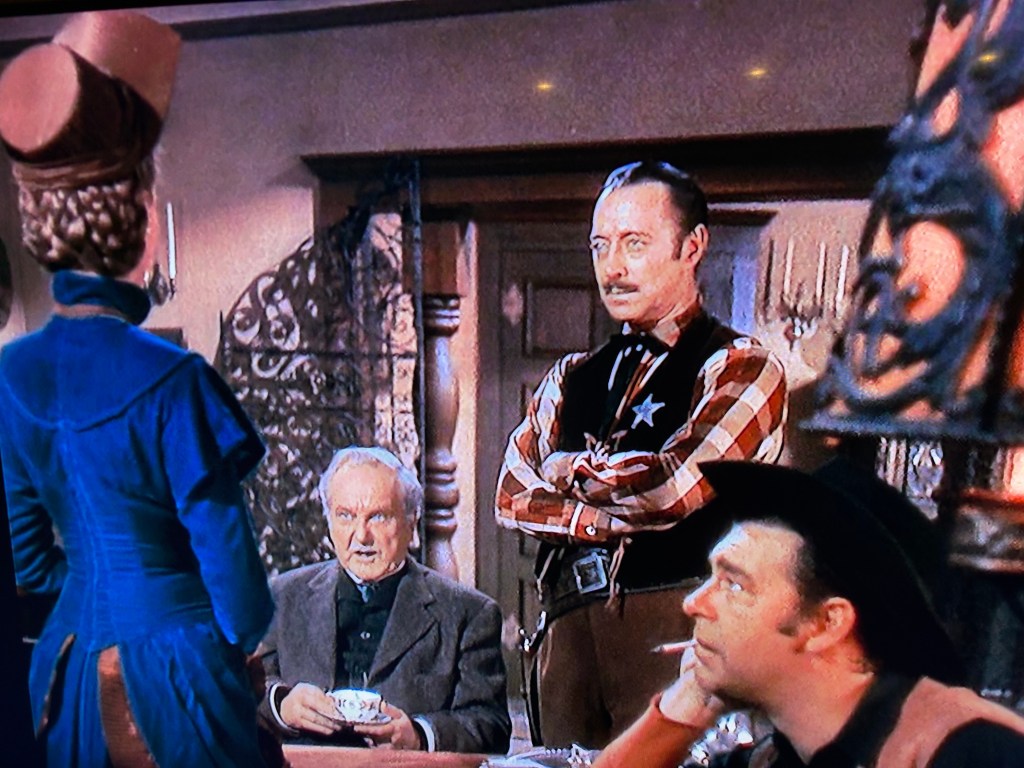
Outside of Britton’s conflicted femme fatale, George Cleveland is suitably despicable as the corrupt business tycoon, while Lon Chaney Jr. (the original Wolfman) is fully committed to his role as the heavy.

One detail I particularly loved about Chaney’s henchman is that he almost always has a cigarette dangling from his mouth, even when he’s riding a horse or getting into a fistfight. Now that’s real dedication to the craft.

As a unit, these shady characters manage to raise the stakes and introduce a little edge into what’s otherwise a pretty sanitized western, which is much appreciated.

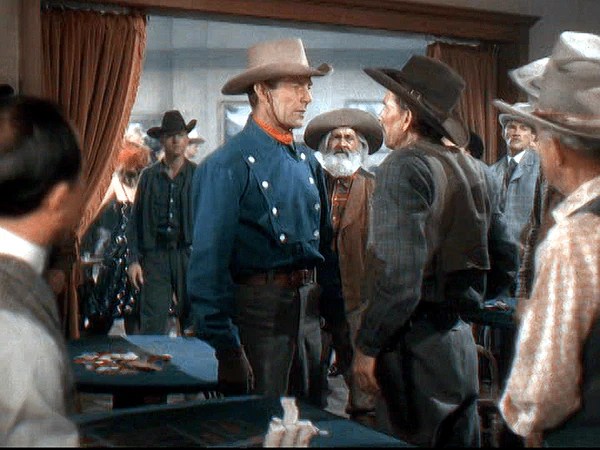
Another impressive element of the film is its use of colour. Despite the movie’s picture process (Cinecolor) being a cheaper alternative to the far more famous Technicolor, the costuming department knew how to make the best of this format by dressing key members of the cast in a vivid combination of blues and reds. This palette is used sparingly (as to not overwhelm the senses), but it remains a consistent part of the film’s visual texture, with Scott’s riding jacket clearly identifying him as the hero in crowded group shots. 

Far less impressive is the film’s stunt work.

I’ve harped on this in the past, but I’ll never get used to how older movies depict people getting shot, where the performers dramatically clutch their chest like they’re experiencing severe heartburn. Albuquerque takes this archaic trope even further by having its stuntmen dramatically faint every time they get a bullet, almost as if they’re Southern debutantes suffering from a serious bout of “the vapors.” It’s a ridiculous sight that immediately drains a scene of any serious drama.

Despite the film constantly being at odds with itself, I still ended up having a good time. As I’ve said before, I’m a sucker for old school westerns and Albuquerque had enough timeless elements to outweigh all the stuff that’s aged like milk. 

Plus, uncovering a gem like Hayes is really going to bolstered my film education. The actor really helped slot a massive pop culture puzzle piece into place that explains where a lot of these classic tropes and character archetypes come from.

And at the end of the day, that’s really what this blog is all about, since I probably wouldn’t have stumbled across this film or Hayes himself if I wasn’t actively rifling through these bargain bin DVD collections to find some buried treasure.

Now if only I could only find a way to get paid for doing this …

Verdict:

6/10

Corner store companion:

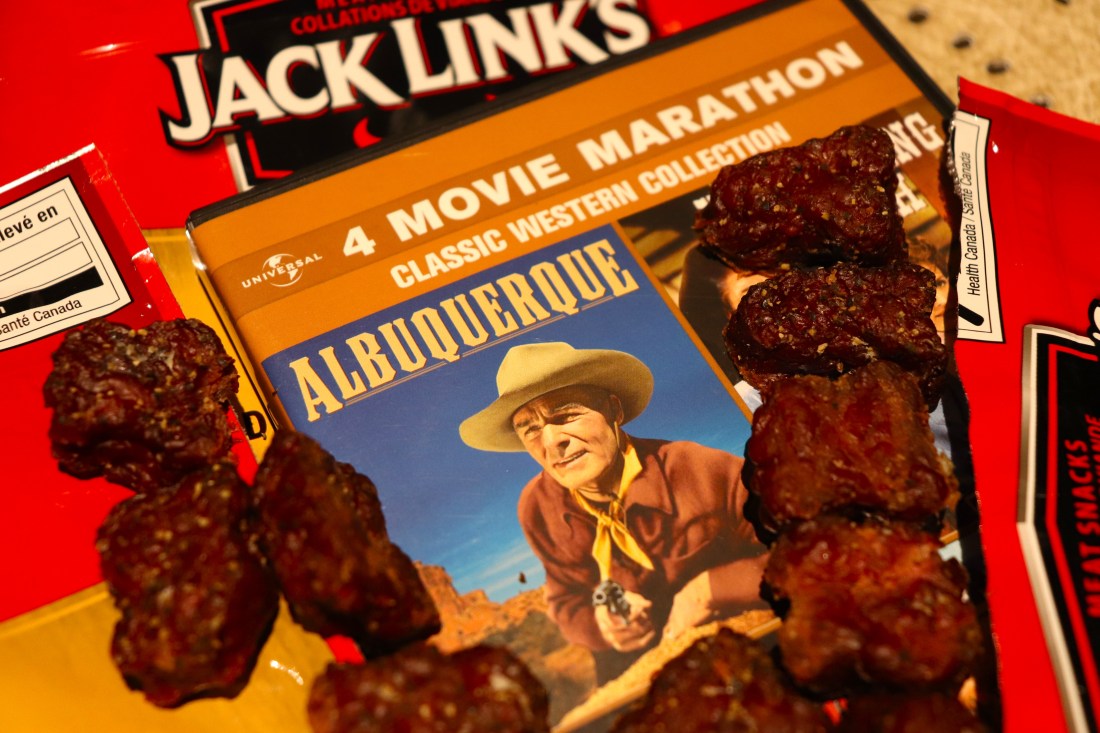
Jack Link’s Original Beef Tender Bites (because it’s a little bland at first, but some flavour eventually manages to work its way in)

Fun facts:

-Release date: Feb. 20, 1948

-Budget: $728,000

-Box office: $1.7 million (US rentals)

–Albuquerque is based on the novel Dead Freight for Piute by prolific western author Luke Short. At least ten of Short’s books have been adapted into films, according to Wikipedia.

-George “Gabby” Hayes brought his talent to dozens of Hollywood westerns throughout the 1930s and 40s, often playing a comedic sidekick to much younger stars. Outside of starring alongside Randolph Scott in six movies, Hayes was also a frequent collaborator with leading men like John Wayne (15 times) and Roy Rodgers (44 times).

-Hayes has two stars on the Hollywood Walk of Fame: one for his contributions to television and another for his work in radio.

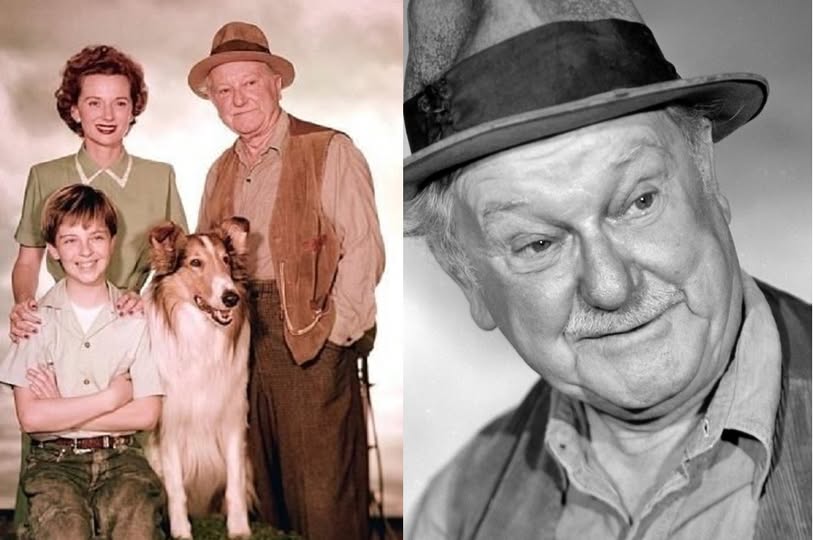
-George Cleveland (who played the villainous uncle in Albuquerque) is probably best known for his role as the grampa in the original Lassie TV show. He appeared in 116 episodes of the program from 1954 to 1957 before passing away at the age of 71.

The Story of Us (1999) review: messy but undeniably heartfelt

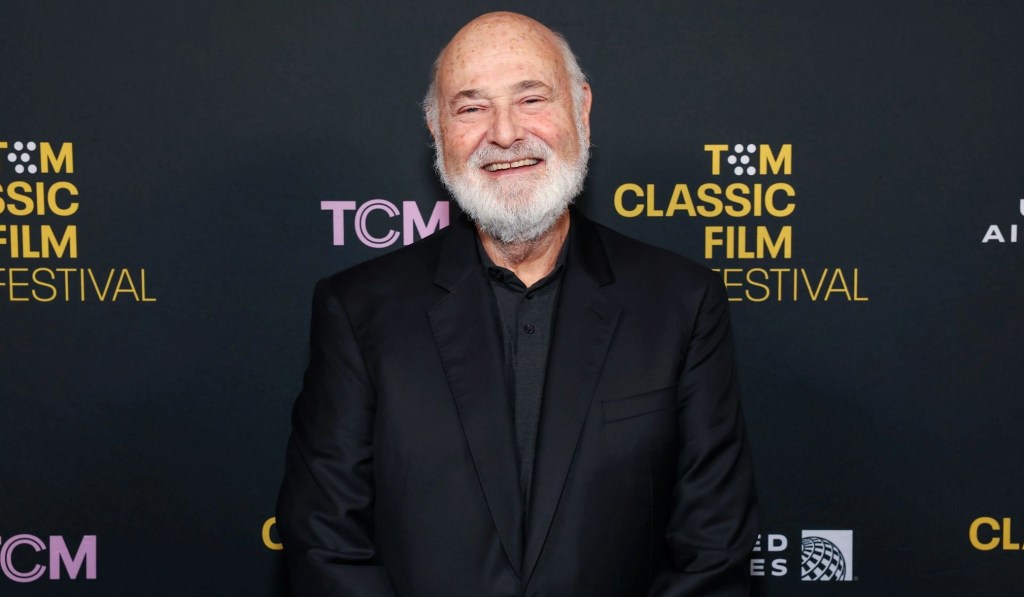
Last year was a non-stop cavalcade of horrific news, with the murder of Rob Reiner and his wife Michele (at the hands of their own son) capping off those rotten 12 months on the worst possible note.

The one thin silver lining to this grim affair was the massive outpouring of love that emerged in its aftermath, where fans, colleagues, and friends commemorated Reiner’s talent as a filmmaker alongside his strong moral fiber as a person.  

From a career perspective, one of the big through lines people focused on was Reiner’s versatility as an artist. Not only was he praised for his roles in front of the camera, but Reiner’s ability to spearhead a variety of genre projects as a director also came into sharper focus.

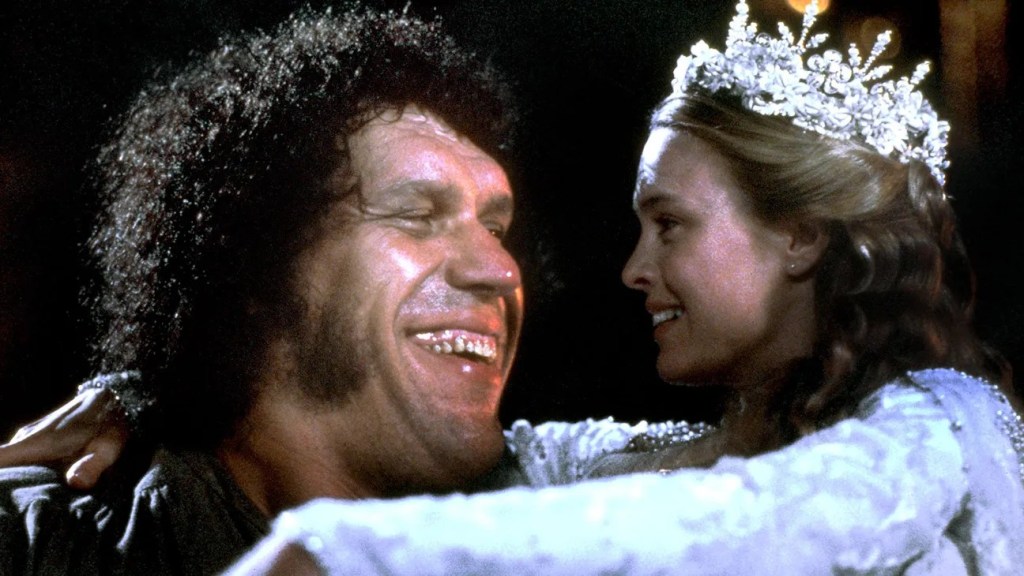
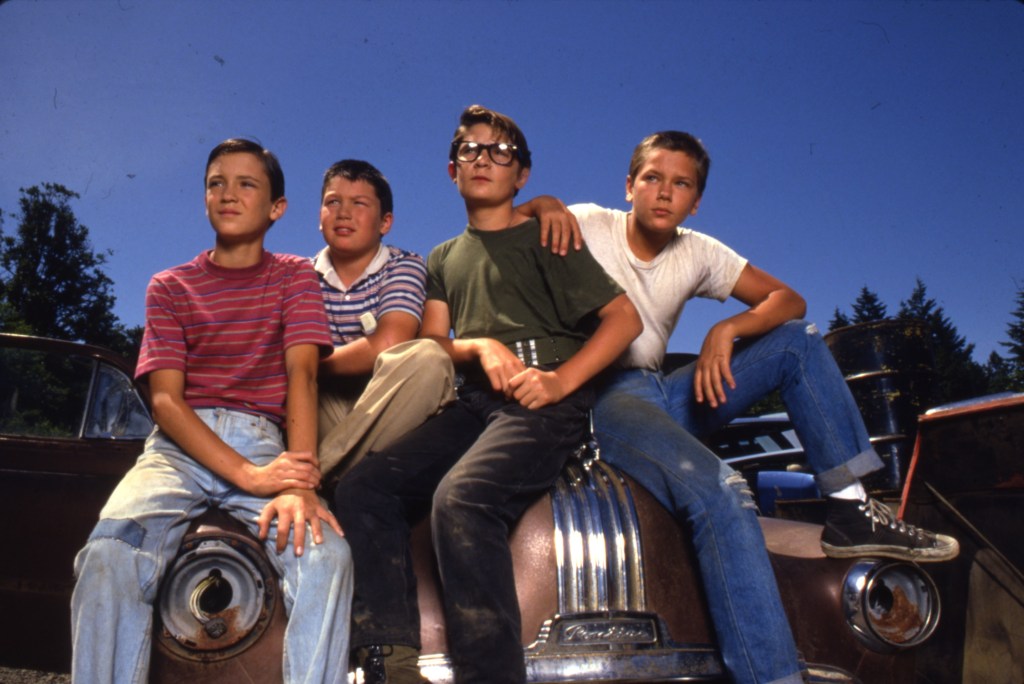
A brief scan through Reiner’s filmography will reveal classic coming-of-age dramas (Stand By Me), fantasy adventure (The Princess Bride), romantic comedies (When Harry Met Sally…), psychological horror (Misery), legal dramas (A Few Good Men), and mockumentaries (This Is Spinal Tap).

One film that wasn’t included in a lot of these wistful retrospectives (at least from what I saw) was The Story of Us (1999), a turn-of-the-millennium romantic drama that charts the troubled marriage of a couple played by Bruce Willis and Michelle Pfeiffer.

Looking at the reviews from that time, it’s easy to see why this film isn’t held in high regard today. On Rotten Tomatoes the movie holds a dubious 28% rating based on 128 reviews, with the critical consensus slamming it as “dull” and “predictable.” The audience score isn’t much better.

However, viewing the film with fresh eyes in 2026, I think The Story of Us is a worthy addition to Reiner’s catalogue, since it manages to embody the sensitivity, humour, and humanity that tied so many of his works together.

The plot of The Story of Us focuses squarely on Ben (Willis) and Katie (Pfeiffer), whose marriage of 15 years is on the verge of outright collapse. When their two children go away to camp for the summer, the couple are left in a state of limbo, not knowing if they should stay together for the kids or just make a clean break.

Ben and Katie’s relationship history is conveyed in a largely non-linear fashion, with the first act of the film being dominated by these brief flashbacks that catch the audience up to speed. Not all of these snippets are told in chronological order, so you’re largely reliant on context clues (like the characters’ changing hairstyles) to figure out when each scene fits into the timeline.

While all this is going on, Willis and Pfeiffer also provide dueling narration from the future, looking back on their turbulent marriage with a healthy degree of hindsight.

On paper, this narrative structure sounds like a mess and, admittedly, it can be a little discombobulating at first. However, I thought the editing team managed to string these disparate pieces together in a way that complimented the story. After all, the disruptive way these short flashbacks are inserted into the film mimics how a lot of people remember the past (i.e. chopped up into disorganized peaks and valleys with flimsy connective tissue in between). Plus, this jigsaw-like storytelling method kept my brain engaged throughout, as I was subconsciously filling in the gaps as the plot progressed.  

The dual narration also serves a purpose beyond just filling dead air. Outside of providing further insight into how each character views their failings as a romantic partner, the ambiguity of their dialogue leaves you hanging in suspense, since it’s not clear if they’re still married until the very end.

That being said, the film does slow down in its second act, with the interruptive flashbacks being dialed back considerably. This breathing room allows Willis, Pfeiffer, and the script to take centre stage, for good and for ill.

On one hand, Pfeiffer puts her all into the role of Katie. She is totally believable as a woman who feels overwhelmed and consumed by her role as a mother, so much so that she doesn’t have anything left to invest into her role as a wife.

Willis, meanwhile, is significantly less believable as the goofy sitcom dad. It’s not like he hasn’t demonstrated some acting range throughout his career, managing to shed that macho, tough guy image for movies like The Kid (2000) and The Sixth Sense (1999). But this role in The Story of Us seems far beyond Willis’ capabilities, especially whenever he’s asked to put on a funny voice or anchor an extended comedy bit.

At least the two of them work well together as a dysfunctional couple. Any scene involving Willis and Pfeiffer arguing or suffering through an artificially cordial dinner with their children is tense, with so much unspoken conflict bubbling beneath the surface.

The script, similarly, has its good and bad moments.

Sometimes, it seems like the writers are lazily treading into Men Are From Mars, Women Are From Venus type territory when the characters discuss how each sex views relationships. An early scene involving Ben and Katie’s respective friends talking about this subject at separate lunch dates seems like the cast of Seinfeld and Sex and the City are being artificially cross cut together.

Additionally, it’s kind of lame that the film’s overriding conflict ultimately gets resolved [SPOILERS] via a profound declaration of love from one of the characters. It just seems like a cheap and easy way to wash away the complicated relationship dynamics that were being explored for the previous 90 minutes.  

Still, the script manages to shine in some other key areas.

For one thing, the film wisely resists the urge to dive into outright melodrama or soap opera shenanigans as a shortcut.

Both Willis and Pfeiffer never committed infidelity, and they don’t resort to hurling kitchenware at each other to make a dramatic point.

Instead, the film shows (mostly through dialogue) that the key reason their relationship fell apart was far more mundane, with unfulfilled dreams, tragic miscommunication, and the growing responsibilities of parenthood creating a rift that’s far too wide to mend.

The filmmakers hammer this idea home by veering off into outright surrealism at one point, with Willis and Pfeiffer attempting to reconcile in bed before being interrupted by the ghostly apparitions of their parents.  A nightmarish scenario, for sure, but it does succinctly illustrate how these characters are products of their own dysfunctional upbringings. 

I also respect the fact that there is no clearcut villain in the story. Throughout the runtime, both characters bring up valid critiques of their partner while simultaneously falling prey to their own insecurities and lashing out. This largely leaves it up to the audience to determine who is in the right or wrong, making you feel, in a way, like you are a kid stuck between mom and dad fighting.

Thankfully, Reiner and his team make this difficult-to-stomach material digestible through several methods.

One is the calming soundtrack composed and cultivated by Eric Clapton, which serves as an acoustic balm that soothes any mental abrasions caused by all the marital strife on screen.

Another source of comfort is some well-placed humour.

While there are definitely some clunkers that don’t land, the film has enough clever lines and witty repartee to ensure that the whole enterprise doesn’t get swallowed up by its own self seriousness.

One of my favourite bits comes from Reiner himself, who plays Willis’ close friend and insists at one point that expecting the “perfect” marriage is as delusional as calling the fatty top of our legs an “ass.”

Several scenes later, Willis, who is suffering a mental breakdown, throws this simile back in Reiner’s face by telling him to shove a bread basket “up the tops of your legs.”

Admittedly, this is not the most refined joke in the world. It was even singled out by Roger Ebert in his scathing one-star review of the film as being an example of why this material doesn’t work.  

But something about Willis’ screeching delivery and Reiner’s calm look of embarrassment really worked for me, elevating what could have been a disposable, juvenile gag by tapping into some genuine human emotion.

That’s kind of the movie’s entire appeal in a nutshell: unsophisticated and sloppy in places, but undeniably earnest in what it’s trying to accomplish.

This material has undoubtedly been explored in better films, with Noah Baumbach’s Marriage Story (2019) and Richard Linklater’s Before Midnight (2013) both providing keener insight into the cataclysmic messiness of a failing marriage.

The Story of Us, while far more scattershot in its execution, at least comes at this difficult subject matter with a great deal of empathy, which is in such short supply these days that I’ll clasp onto anything that attempts to bring a civilizing force back into conversations surrounding relationships.

That humanizing eye is really what made Reiner as a filmmaker, with many of his most famous works eschewing brash cynicism in favour of celebrating the humanity of the characters on screen.

So with that in mind, perhaps it’s time to give The Story of Us another look for those who dismissed it 27 years ago.

It may not be perfect and doesn’t come close to eclipsing Reiner’s outright classics, but watching this movie at least puts the filmmaker’s career, as a whole, into better perspective, which is a worthwhile exercise now that he’s no longer with us.

Verdict:

7/10

Corner store companion:

Ocean Spray Sparkling Pink Cranberry Beverage (because it’s light and refreshing, which should wash the unpleasant taste of a failing marriage out of your mouth)

Fun facts:

-Release date: Oct. 15, 1999

-Budget: $50 million

-Box office: $58.9 million

-Reiner had directed 29 features before his untimely death, with his final film being Spinal Tap II: The End Continues (2025). A follow-up concert film titled Spinal Tap at Stonehenge: The Final Finale was completed and scheduled to be released this year, but has been delayed due to Reiner’s death.

-Both Willis and Pfeiffer were dealing with some serious personal strife at the time of filming. Willis was going through his own divorce with Demi Moore, while Pfeiffer was grappling with her father’s death and the dissolution of her production company (Via Rosa Productions).

–Musical highlight: “Classical Gas” by Mason Williams (plays over a pivotal scene in the third act when one of the characters has an epiphany)

-This film can currently be watched in its entirety on YouTube

Tangier (1946) review- discount Casablanca

In modern film discourse, it’s pretty easy to call something derivative or a “rip-off.”

After all, we have over 120 years of movie history to pull from, which gives us the breathing room to spot repeated uses of certain plots, settings, and character archetypes over a period of time.  

Movie-goers from the 1940s-50s, meanwhile, weren’t burdened with the same historical hindsight and couldn’t even rely on the internet or home video releases to keep track of every time Hollywood re-used the same picturesque rock formation for a generic western backdrop.

But even with that all in mind, I still think 1946 audiences would have tilted their heads at George Waggner’s Tangier, given how many elements it blatantly lifts from Michael Curtiz’s Casablanca (1942).  

After all, Casablanca was a massive hit that netted Warner Brothers some major Oscar wins (including Best Picture), thereby guaranteeing it a firm place in the American pop culture zeitgeist.

The film’s success also encouraged Warner Brothers to produce several other films made in the same mold, with The Conspirators (1944) and To Have and Have Not (1944) liberally borrowing cast members and plot elements from Casablanca.

So by 1946, US movie fans were quite familiar with film noir set in exotic locales, where glamorous women and hard-nosed men fall in love while bringing down fascist sympathizers.

And Universal Pictures was definitely hoping to cash in on that formula with Tangier, resulting in a product that often looks and feels like Casablanca with the serial number filed off.

Despite being such a blatant knock-off, Tangier manages to retain some charm thanks to its strong cast, sharp dialogue, and moody visuals, which keep the film’s more derivative aspects at bay (for the most part).  

That being said, the parallels between Tangier and Casablanca are nakedly obvious even from a surface reading of the plot.

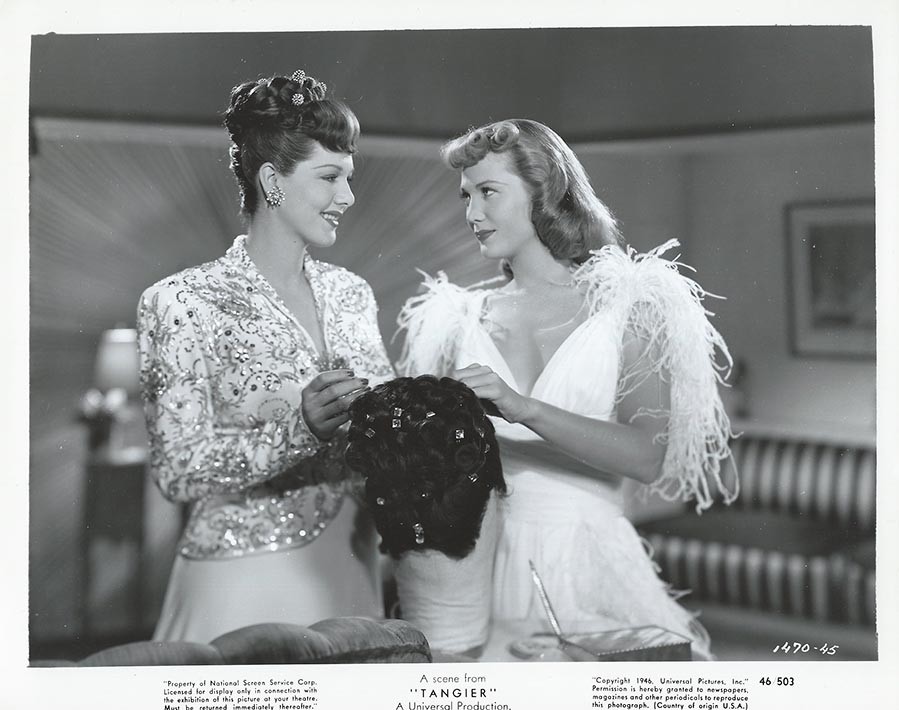
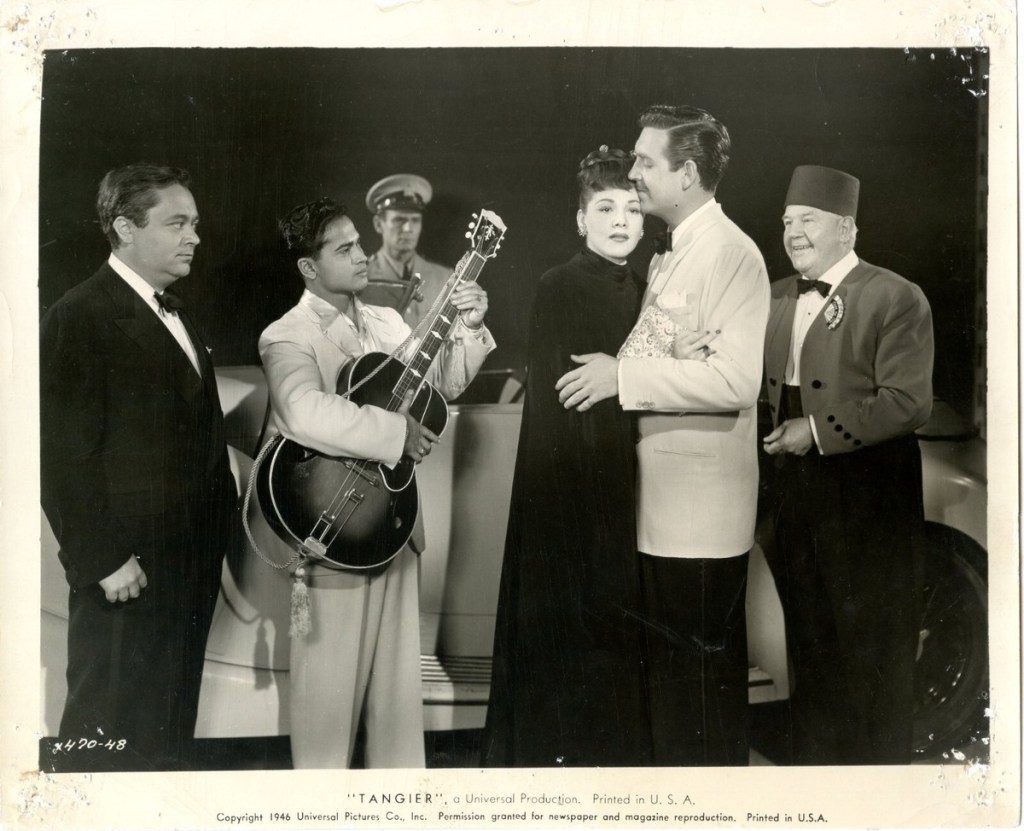
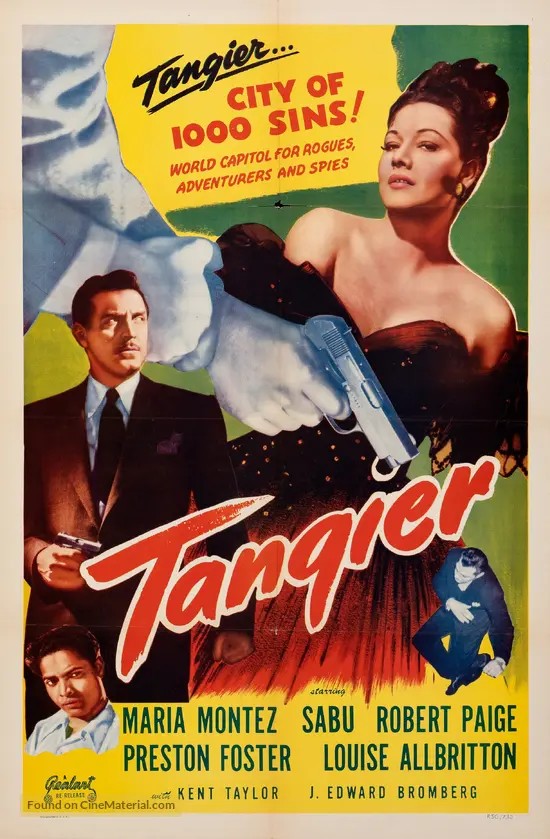
In both films, the setting is a coastal Moroccan city during World War II, with most of the action revolving around a glitzy nightclub that is frequented by all the big movers and shakers in town. The “usual suspects” in Tangier are led by American journalist Paul (Robert Paige), who is on the trail of a Nazi collaborator attempting to buy his freedom using a stolen diamond. Paul’s quest eventually intersects with club dancer Rita (Maria Montez), who is on the trail of the same Nazi collaborator for personal reasons. The two eventually team up to recover the diamond and bring the secret Nazi to justice, all the while making bedroom eyes at each other.

Even someone with a cursory knowledge of Casablanca could pick up on the similarities at play here. Not only is Tangier’s setting and overriding conflict virtually the same, but the romance at the centre of the story occupies the same emotional space that Humphrey Bogart and Ingrid Bergman did in the 1942 film.

In that respect, Tangier definitely pales in comparison, with the romance between Paige and Montez feeling rushed and undercooked. Even if the two have decent chemistry, their relationship develops far too quickly, with the pair agreeing to marry after only knowing each other for a single day.

The filmmakers try to compensate for this weak romance by throwing a four-way love triangle (a love square?) into the mix, but that only serves to complicate what’s already an overstuffed plot.

Luckily, most of the sights and sounds surrounding the central romance are interesting enough to keep the rest of the film on track.

Despite not really working as a couple, Paige and Montez know exactly how to play up the film noir aspect of the story. Paige’s war reporter has a roguish Hemingway flair about him, whereas Montez is totally believable as a femme fatale whose glamour is ultimately a means to end.

The supporting cast is also a rich tapestry of character actors from Hollywood’s Golden Age, who manage to squeeze a lot of life out of what are otherwise stock noir archetypes.

Louise Allbritton shines as a fellow club dancer who is constantly standing in Montez’s shadow, both professionally and romantically. In less talented hands, Allbritton could have come across as whiny or annoying, but she manages to hit all the right notes and make this character a genuinely tragic figure.

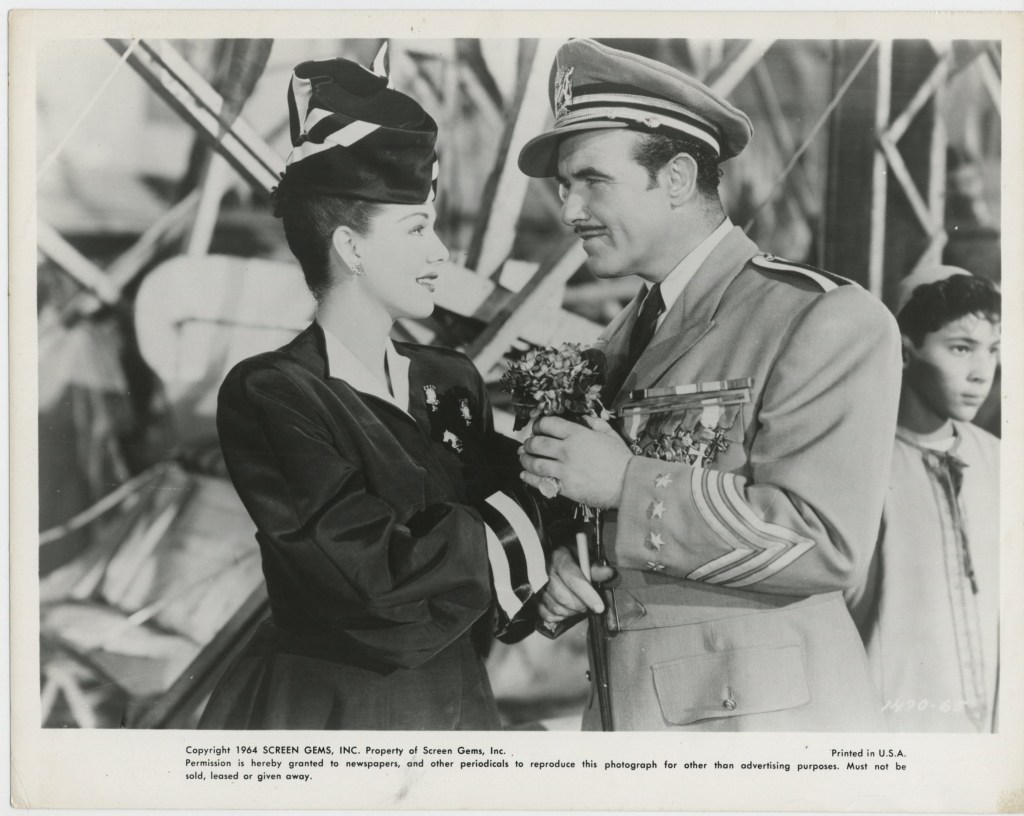
Meanwhile, Sabu is playing largely the same role that Dooley Wilson (Sam) occupied in Casablanca, namely the musical sidekick who is a confidant to the main hero. There’s definitely a lot of cultural baggage to unpack with this type of character, but, for what it’s worth, Sabu uses his natural charisma to inject some much-needed levity into the film.

And then there’s Preston Foster as the stuffy military police colonel, who is the main obstacle standing in the heroes’ way. Again, this sounds like a generic villain role on paper, but Foster manages to imbue his character with a kind of gentlemanly poise that makes him at least fun to watch.  

It also doesn’t hurt that the film’s overall production values are quite high, from the sets to the costumes to the classic film noir lighting that scratches a major itch for a certain breed of cinephile.

Like the best examples of the genre, the dramatic lighting filters through blinds, latticework, and prison bars, giving all the action a layer of texture that communicates awe and menace simultaneously.

The snappy dialogue is just the icing on the cake, with the cast effortlessly navigating through a steady stream of quips, comebacks, and double entendres that one would normally associate with an energetic stage play.

Unfortunately, some sound filmmaking around the edges can’t take away from the fact that Tangier doesn’t bring anything new or unique to the table to distinguish itself from other entries in the genre.

The Casablanca parallels really do drag everything down, with the filmmakers behind Tangier even having the gall to end their movie [SPOILERS] with the main characters escaping via an airfield. Where on Earth did they get that idea?

But beyond that, there’s a general sense that the filmmakers are running on autopilot, relying on the talented cast and crew to bail out what’s ultimately an unremarkable script.

Even the casting department didn’t think too deeply about who best to inhabit these characters. This film is inundated with far too many male actors with slicked back hair and pencil-thin mustaches, making it hard to tell who’s who for the first 20 minutes or so.

Still, if you have no knowledge of the films Tangier is cribbing notes from, it’s a fairly entertaining watch. Nothing life-changing of course, but it taps into an appealing vibe and aesthetic that is impossible to deny.

Plus, it’s difficult to be too harsh on a movie that takes inspiration from one of the most influential films of all time. Casablanca left a massive impact on the entertainment industry following its release, so much so that specific clips from that film are still being used as visual shorthand for what classic Hollywood romance is supposed to look like on screen.

So it’s only natural for that influence to worm its way into a bunch of other projects, whether the filmmakers are aware of that or not.  

In the case of Tangier, I’m pretty sure Waggner and his writers knew exactly what they were doing, since there are too many glaring similarities between the two films to ignore.

The end result is like watching a really talented cover band play through all your favourite hits; sure, you appreciate the craft and skill on display, but can’t escape that sinking feeling that a genuine creative spark is missing.

Verdict:

6/10

Corner store companion:

Compliments macaroni and cheese (because it’s a cheap alternative to the real thing, but it still gets the job done)

Fun facts:

–Release date: June 6, 1946

-Tangier was one of the last films to be released under the “Universal Pictures” banner before the studio merged with International Pictures and was reorganized as “Universal-International” in July 1946.

-Following the release of Tangier, Maria Montez would only appear in nine other films before suffering a heart attack and drowning in her bathtub on Sept. 7, 1951. She was 39 years old.

-Leading man Robert Paige later became a TV newscaster in the 1960s, reporting out of Los Angeles for ABC News.

-After a multi-decade career in the film business, George Waggner transitioned to working in television in the 1960s, directing episodes of Batman, The Green Hornet, and The Man from U.N.C.L.E.

Battle Creek Brawl (1980) review: rough-around-the-edges charm

A universal rule of life is that you only get one shot at making a good first impression, and that fact extends to big time celebrities as well.

Movie studio execs almost certainly had this maxim in mind during the production of Battle Creek Brawl (1980), since it marked Jackie Chan’s inaugural attempt to break into the U.S. film market.

Even though the Hong Kong martial artist had cultivated a series of hits in Asia, his star power remained an unproven commodity in the West.

So, to roll out the figurative red carpet, Warner Bros. producers did all they could to make Chan palatable to Western audiences, going so far as to hire the same director (Robert Clouse) and crew responsible for introducing Bruce Lee to the world in Enter the Dragon (1973).

While Lee became a household name thanks to that movie, Chan was less successful with Battle Creek Brawl, and would have to wait another 16 years before he truly “arrived” in the U.S.

Watching this movie today, it’s easy to see why Battle Creek Brawl didn’t connect with audiences or critics the way some hoped, since Chan’s signature kinetic movements are much more reserved compared to his other works.

Despite these limitations, Chan’s best qualities as a performer still manage to shine through, making this film an interesting historical artefact and decently entertaining action flick at the same time.

For his American film debut, Chan plays Jerry, a Chinese American living in 1930s Chicago with his family.

Jerry’s strong moral convictions and love of martial arts cause him to run afoul of some local gangsters, who repeatedly threaten his family through physical intimidation and eventually a kidnapping.

Through this kidnapping, the mob blackmails Jerry into entering a Texas street fighting tournament on their behalf, leading to a life-and-death struggle where his combat skills are put to the ultimate test.

Like a lot of Jackie Chan movies, the plot of Battle Creek Brawl isn’t that original or sophisticated. Instead, it mostly serves as a narrative device to string together a series of action sequences that showcase the star’s pure athleticism and daredevil charisma.

Having said that, the story here is particularly threadbare, with certain important plot points being brought up and totally forgotten by the end.

The worst example of this sloppy writing is the aforementioned kidnapping, where the bad guys snatch Jerry’s sister-in-law off the street and use her as leverage to get him to enter the fighting tournament. The mobsters then replace the sister-in-law with a decoy to ensure that the rest of his family aren’t tipped off to their sinister machinations.

This serves as a decent set-up for the third act, where the stakes are raised and Chan’s character is fighting for something more than just money and personal pride. The problem is that we never see these two women (the sister-in-law or her decoy) again after their initial introduction, and the whole kidnapping business is (I assume) resolved after the credits roll.

By failing to resolve these plot threads, the film’s finale is severely lacking in emotional payoff, leaving me with the bewildering feeling that I hit the “skip” button on my remote by mistake.

Equally confusing is the movie’s production design and costuming, which is a total mess in terms of maintaining a consistent look and feel for the established 1930s setting.

Nowhere is this more apparent than in the film’s underground roller derby scene, where the participants are wearing funky jumpsuits pulled right out of a 1970s disco dance lineup.

The film’s fighting tournament finale is also littered with background extras who are similarly out of place, including all the on-duty cops who (based on their uniforms) look like they spend most of their time chasing after the Dukes of Hazzard.

I know this all sounds like trivial details that shouldn’t amount to much, but it just points to the fact that the filmmakers’ commitment to making a period piece was half-hearted at best, making me question why they decided to take this route in the first place.

Of course, all this shoddy craftsmanship can be forgiven if the film delivers on its main course, which is Chan’s signature mix of comedy and martial arts that endeared him to generations of action movie fans.

On that front, Battle Creek Brawl is more of a mixed bag.

Compared to the insane stunt choreography that Chan would put together throughout the remaining 1980s and 90s, the fight scenes here are noticeably slower and more restrained.

This diminished work rate is clear from Chan’s opening scuffle, where it seems like he’s going out of his way to not hurt the American stunt team.  

A noticeable lack of coordination is also present during the anachronistic roller derby, which is a fun sequence in concept but remains a little awkward in terms of execution.

That said, Chan performing at half speed is still a sight to behold, and the filmmakers do at least have the good sense to put him front and centre when it matters.

Chan’s status as a fearless stunt man is firmly established from the get-go, with his character being introduced in a scene where he fearlessly swings around the top of a bridge without any wires holding him up.

The movie also features plenty of solo training montages sprinkled throughout the runtime, where the camera is singularly focused on Chan’s impressive athleticism through long, uninterrupted takes.

Plus, as the movie goes on, it seems like the stunt team does eventually hit their stride, doing a decent job of synthesizing the action-comedy formula that Chan would go on to perfect in the subsequent decades.

The filmmakers are also good at keeping things unpredictable by adopting a “why not” approach for some of their fight scenes.

My favourite example of this kitchen-sink strategy takes place during the quarter finals of the fighting tournament, when Chan’s opponent gets tired of using his fists and opts to just run him over with a stolen police car.  

However, the most impressive element of Battle Creek Brawl is how it manages to maintain a fun and charming vibe outside of its fight scenes.

Much of this is due to Chan, who remains a likable underdog protagonist even in quieter scenes involving his girlfriend (Kristine DeBell) or mentor (Mako). This feat is especially impressive when you consider the fact that Chan had to learn all his English dialogue phonetically for this film and didn’t rely on someone else to dub in his lines later.

The film’s supporting cast is equally responsible for cultivating this breezy atmosphere, with actors like Mako and José Ferrer being just as entertaining as Chan when fists aren’t flying.

Mako comfortably slots himself into the classic role of the martial arts mentor, putting Chan through his comedic paces as a surly chiropractor who has a weakness for Rubenesque women.

And Ferrer brings a surprising amount of laidback charisma to the table as the film’s main villain. Rather than spend his time snarling and lacing every line with creeping menace, this Chicago mob boss is far more affable when it comes to his criminal dealings, perfectly falling in line with the movie’s lighter tone.

These charming elements are also wrapped up in the film’s eclectic score, which mixes Spaghetti western whistling with some heavy jazz base lines.

Like a lot of Battle Creek Brawl, these disparate musical influences shouldn’t work when fused together. But, against all odds, the score eventually becomes a catchy earworm that’s perfectly synced up to the movie’s pervasive silliness.

Ultimately, the filmmakers’ refusal to take themselves too seriously is what saves this project from completely collapsing in on itself.

Had the movie detoured into dramatic pathos or over-the-top grizzly violence, then all of its bad writing and technical shortcomings would stick out even more.

But by keeping things fun and light throughout the entire runtime, Battle Creek Brawl remains an endearing viewing experience despite its many rough edges.

It’s the film equivalent of that weird guy you meet at a party who is a little off-putting at first, but he eventually wins you over due to his wholesome nature and infectious humour.

That’s essentially Chan’s relationship with Western audiences, since his hard work and raw talent (expertly showcased in this film) would eventually pay off and result in him becoming one of the biggest movie stars in the world.

So forget what I originally said about first impressions being the end all, be all. Sometimes life gives you countless opportunities to prove your worth. You just have to be willing to put it all on the line and pick up the pieces in case of tremendous failure.  

Thank you for coming to my TED Talk.

Verdict:

6/10

Corner store companion:

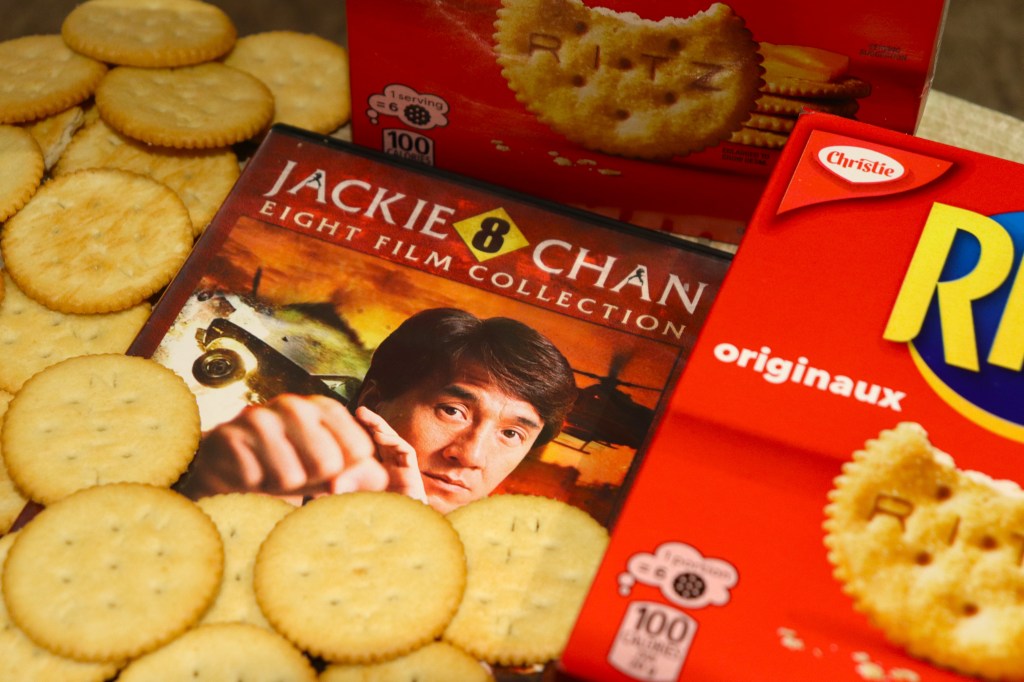
Ritz crackers (because this food item is pretty plain by itself, but serves as a good foundation for future projects)

Fun facts:

Release date: Sept. 10, 1980 (U.S.)

Budget: $6 million

Box office: $21.5 million

-Alternate titles: The Big Brawl, Killer’s Trench

–Chan finally received his major North American breakthrough hit with Rumble in the Bronx (1995). Not only was Rumble popular with fans and critics (even screening at the 1996 Sundance Film Festival), but the movie made back nearly five times its budget thanks to its run in international markets.  

-Fans of Avatar: The Last Airbender may get a kick out of Mako’s role in Battle Creek Brawl. In both properties he plays an unconventional master arts master who loves tea and dishing out words of wisdom to his nephew.

–Battle Creek Brawl marks the first time Chan’s authentic voice was heard in a movie. Before this film, all of Chan’s previous work was dubbed in Cantonese or Mandarin by another actor.

-Both Chan and Mako would go on to voice Master Splinter in different screen iterations of the Teenage Mutant Ninja Turtles. Mako would lend his voice to the character in 2007, while Chan was cast to give Splinter life in 2023’s Mutant Mayhem.  

–Battle Creek Brawl can be watched in its entirety on YouTube for free (with occasional ads breaks)

Coneheads (1993) review-good ideas, subpar execution

Life-long fans of Saturday Night Live have been eating well over the past eight months.

Not only did SNL air its 50th anniversary special earlier this year, but the 2024 fall movie season graced us with a high-profile feature film chronicling the sketch comedy show’s inaugural broadcast in 1975.

As a casual fan, it’s still hard to believe this show has been on the air for half a century, serving as a pop culture incubator for several generations of comedy superstars (not just Molly Shannon).

SNL has had such a lengthy run that its producers have been trying to mine nostalgia for certain sketches as far back as the early 90s.

While Wayne’s World (1992) was greenlit to capitalize on a skit that was popular at the time, Coneheads (1993) was a much more confusing prospect, since those characters hadn’t appeared on TV (in live action) since 1979.

But SNL creator Lorne Michaels, in his infinite wisdom, clearly thought that people would flock to the theatres to watch Dan Aykroyd shuffle around in a phallic cranial prosthetic, since he managed to secure a $30 million budget for this project.

In retrospect, this probably wasn’t the wisest of investments, since Coneheads was a commercial and critical flop, harbingering the public’s less-than-stellar reception to SNL movies over the remaining decade.

While I’d like to be a typical film bro contrarian and tell you how critics and audiences were wrong for casting this movie aside, it’s hard to break from this consensus over 30 years later.

As it stands, the Coneheads movie is just off putting and unpleasant a lot of the time, even though its central schtick did eventually grow on me.

For this film adaptation, Aykroyd and Jane Curtain reprise their roles as Beldar and Prymaat, two aliens from the planet Remulak who crash land on Earth.

With repair to their spaceship impossible and rescue being years away, the extraterrestrial couple must carve out a living amongst the humans, all the while eluding the U.S. government.

While Coneheads has plenty of faults, the filmmakers at least do a better job of justifying its existence compared to other SNL movies.

Unlike Superstar (1999) or The Ladies Man (2000), the plot and characters are far better suited to a feature-length runtime. Beldar and Prymaat’s struggle to navigate life on Earth actually evolves over time, and the writers put in some nice details that parallel their story with the American immigrant experience.

Probably the best example of this is when the film introduces Connie, the couple’s offspring whose upbring on Earth clashes with her alien heritage.  

Not only does Connie take to human customs (like shopping and blasting popular music) much more naturally, but actress Michelle Burke also embeds this generational divide into her performance by shedding her parents’ nasally monotone in favour of a kind of Valley Girl accent.

This injects the movie with a tangible sense of thematic conflict, giving the characters a lot more to do in the second half of the film beyond leaning into jokes about the Coneheads’ strange biology and inability to understand idioms.

The producers should also be commended for putting that $30 million budget to good use, leaning into the sci-fi aspect of the story by staging impressive scenes of space travel and a charming stop-motion monster fight on Remulak.

Unfortunately, you have to wade through a lot of unfunny BS to arrive at the goods parts, with the first third of the movie being a major slog.

Maybe it’s because I wasn’t familiar with these specific SNL skits ahead of time, but my introduction to the Coneheads’ signature tics and idiosyncrasies in this film was like hitting a brick wall.

Within the first ten minutes, Aykroyd and Curtain’s screeching and cartoonish mugging had already grown tiresome, and I seriously considered turning down my TV’s volume to minimize the impact.

To make matters worse, the first third of the film relies on a lot of shock humour that isn’t clever or insightful, with many of the gags boiling down to the writers thinking “what’s the grossest thing we can shove into Aykroyd’s mouth?”

That being said, I do admire the filmmakers for testing the boundaries of the MPAA rating system by smuggling grotesque body horror into a PG movie.

In one scene, Beldar goes to a dentist to file down his teeth and reveals several rows of hideous fangs behind his retracted mouth.

In another moment, a pregnant Prymaat floods an entire basement apartment when her water breaks, leading to a baby delivery scene where Beldar cuts the umbilical cord with his new teeth.

Even the climactic fight at the end has some pretty grizzly sights for a kids movie, since a couple Remulak jobbers get their head and limbs torn off by a stop-motion space troll.

While these gags barely elicited a chuckle out of me, I at least respect the writers’ willingness to make the audience uncomfortable and not settle for a completely sanitized experience.

Unfortunately, Coneheads is still meant to be a comedy and in that area the film mostly falls flat.

Outside of its overreliance on gross-out humour, the film’s remaining jokes become pretty predictable and fall into a familiar pattern, where misunderstandings about Earth culture are sandwiched between cracks about the Remulak’s unique physiology and speaking patterns.

That repetition may not be noticeable in an eight-minute sketch, but every subpar gag becomes magnified in a feature-length environment, and Coneheads doesn’t have enough standout lines or bits to even out this ratio.  

And even though the actors do the best with the material they’re given (especially Curtain), one puzzling casting decision really threw me for a loop and torpedoed a romantic subplot that dominates the second half of the film.

This story thread revolves around Connie’s growing infatuation with Ronnie, an auto mechanic played by Chris Farley.

While Farley (rest in peace) was a man of many talents, he definitely looked his age and should have never been hired to play a character who is lusting after a teenager.

Even if Farley’s character is meant to be 18 or something, the scenes between him and Burke come off as extra weird and creepy, which is a major problem when so much of the story’s emotional weight is reliant on their relationship.  

You could argue that this creepy dynamic is intentional, since the movie thrives on this kind of absurdist contrast, like how all the human characters never once remark on the Coneheads’ freakish appearance as being alien.  

But Farley’s casting seems like it’s moreso a matter of convenience, since the rest of the cast is chock full of comedians who were already in SNL’s orbit during the early 90s.

So overall, I can’t really recommend Coneheads as a comedy, although I do admire some of the work being done at its core.

The writers at least had a solid foundational idea to play around with by using Beldar, Prymaat, and Connie to mirror the American immigrant experience. This framing gives the movie a sense of momentum as the plot moves forward and it never feels like the film is a series of random skits strung together with a loose plot.

This story about undocumented aliens becoming productive members of society is also especially relevant in today’s political climate, where the current U.S. government is so cartoonishly cruel and draconian in its treatment of these people that it makes the film’s main villain (an overzealous immigration agent played by Michael McKean) look like a choir boy by comparison.

Had the jokes been a little sharper, I believe that Coneheads would be on the same tier as beloved SNL features like Wayne World or The Blues Brothers (1980), rather than being relegated to the middle of the pack.

Thankfully, two of the movie’s writers (Bonnie and Terry Turner) would later find success creating 3rd Rock from the Sun, an NBC sitcom that used the same basic premise as Coneheads and even featured Curtain as a series regular.

Not only did 3rd Rock run for six seasons, but the show also picked up eight Primetime Emmys throughout its run, including multiple wins for series leads John Lithgow and Kristen Johnston.

So clearly this writing team had the talent to make this concept work; they just needed the right platform to give it room to breathe.

In that sense, the Coneheads movie could be seen as a (very expensive) learning experience, where the writers were given space to see what doesn’t work, refine their craft, and become better comedians down the line.

That opportunity to learn and grow is what draws so many up-and-coming comedians to SNL even in the 2020s, so Coneheads should at least be praised for staying true to that spirit of self-improvement.  

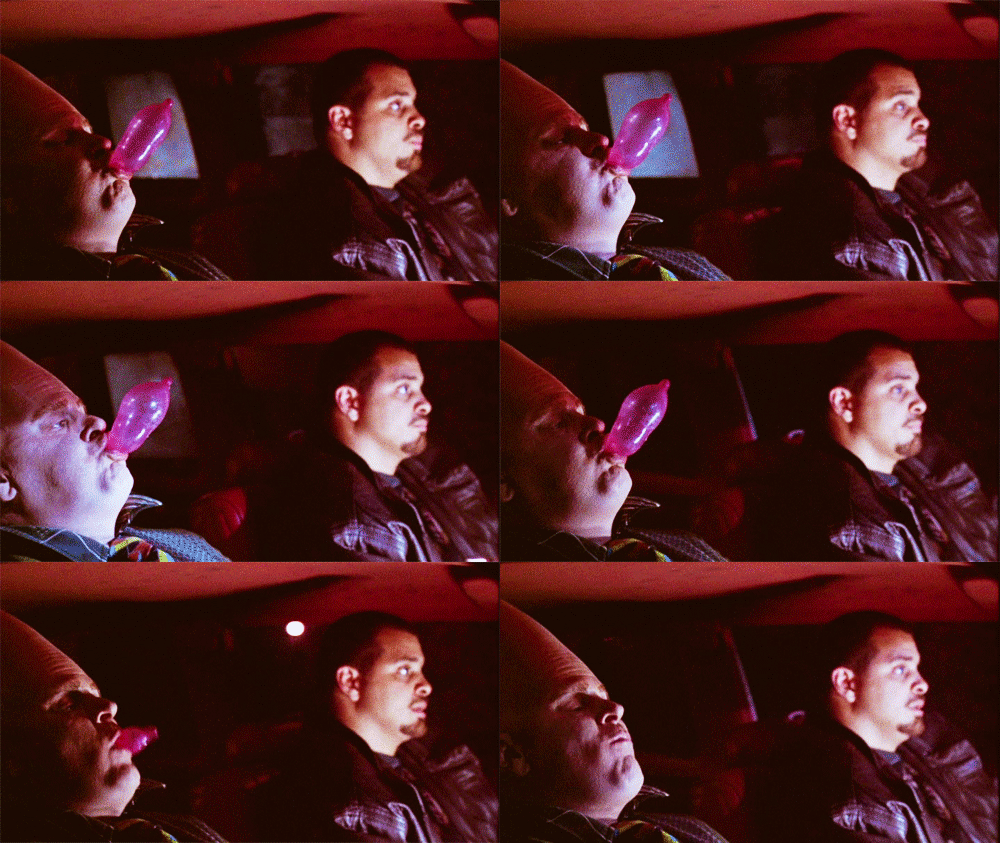
Then again, I had to sit through multiple scenes of actors chewing on condoms like bubble gum, so my positive feelings for this film can only go so far.

Verdict:

5/10

Corner store companion:

Toblerone (because it’s triangle shaped and meant to be consumed in mass quantities)

Fun facts:

Release date: July 23, 1993

Budget: $30 million

Box office: $21 million

-The Coneheads made a total of 11 appearances on SNL between January 1977 and February 1979.

-The Coneheads movie features a smorgasbord of cameos from established comedians and up-and-comers who would go on to be majors players in the industry. This list of cameos includes: Adam Sandler, Drew Carey (in his film debut), Ellen DeGeneres, Sinbad, Eddie Griffin, Jon Lovitz (uncredited), Kevin Nealon, Phil Hartman, Tom Arnold, Parker Posey, Dave Thomas, Tim Meadows, and Michael Richards.

-Aykroyd and Curtain perform the original song “Conehead Love” over the credits in character as Beldar and Prymaat. This song would receive the full music video treatment to help promote the film.  

-Prior to this film, SNL tried to turn the Coneheads into an ongoing cartoon series in 1983 via animation giant Rankin/Bass. The 22-minute special, which was never picked up for a full series, follows a lot of the same plot beats as the 1993 film, with Beldar and Prymaat crashing landing on Earth and adjusting to life amongst humans.

-Despite never scoring a sequel or returning to SNL as these characters, Aykroyd and Curtain reprised their roles as Beldar and Prymaat in a series of commercials for State Farm in 2015.

-Musical highlight: “Kodachrome” by Paul Simon (plays over a montage of Beldar and Prymaat raising their daughter in the suburbs)

Shooter (2007) review-just off the mark

Lately, I’ve been getting this sinking feeling that certain genres of film are becoming completely irrelevant to modern audiences. This endangered species list includes any thriller or drama that touches on contemporary U.S. politics, given how chaotic, fractured, and patently absurd the real-life machinations of the current administration are. After all, how can a Hollywood screenwriter compete with the sheer ludicrousness of SignalGate or top the cartoonish villainy exhibited by a shifty interloper like Elon Musk?

In this context, Antoine Fuqua’s Shooter (2007) seems pretty tame by comparison. This is because the film’s U.S. government baddies are at least marginally intelligent and vaguely discreet when it comes to enacting their evil plans, not at all like their modern, real-world counterparts.

But regardless of the differences between Bush and Trump era politics, these conspiracy-themed thrillers can be a lot of fun, as long as they have a decent script, smooth pacing, and some tight direction.

Shooter definitely excels in a few of these areas, providing the perfect kind of disposable action movie fluff to watch on a lazy Sunday afternoon alongside your dad.

Unfortunately, the film is also weighed down by a weak lead performance and far too many genre cliches, making it hard to distinguish from the dozens of other “one man army” stories clogging up your local DVD bargain bin or drugstore book rack.

The eponymous “Shooter” in this film is Mark Wahlberg, who steps into the boots of elite Marine sniper Bob Lee Swagger. Despite being retired from the U.S. military for several years, Swagger is pulled back into service by Colonel Isaac Johnson (Danny Glover), who needs his help to thwart a presidential assassination attempt. However, the job quickly reveals itself to be a set-up, with Swagger being blamed for killing the Archbishop of Ethiopian (who was standing next to the American president during the shooting). Now on the run, Swagger must clear his name and get to the bottom of a vast conspiracy that reaches all the way to the U.S. Senate.

Like I mentioned at the top, the film’s major weak link is Wahlberg, who does very little to elevate this material above your standard action schlock.

Sure, Marky Mark pulls off the right rugged look and is convincing when he’s holding a gun. But there’s very little in his performance that helps engage the audience on an emotional level.

One moment that stuck out to me was when Swagger’s love interest (Kate Mara) tells him that the bad guys killed his dog. Rather than reacting with piercing sadness or explosive anger over the murder of his best friend, Wahlberg responds with mild annoyance, like someone just told him that he needs to replace his Brita filter.

Unfortunately, Wahlberg remains stuck in this subdued acting mode for most of the film’s runtime, offering only brief glimpses beneath his stoic persona.

I’m not suggesting he needed to break down crying every five minutes to be more relatable or whatever, but some psychological insight would have been welcome.

Maybe this could have been accomplished through casting an older actor, someone capable of bringing a genuine world-weary quality to the role.

According to IMDB, men like Clint Eastwood, Tommy Lee Jones, and Harrison Ford were all considered for the part, which sounds like a much better fit for the vibe the movie was trying to convey.

But to be fair to Wahlberg, the film’s script doesn’t do him any favours.

Despite being established as a conspiratorial shut-in (who lives in the mountains and reads the 9/11 Commission Report for fun), Swagger is surprisingly willing to trust this shadowy government figure (Glover) and fall for the most obvious frame up job of all time.

So when he’s betrayed and literally shot in the back, I was left wondering why Swagger didn’t have any contingency plans in place, since being a rigid individualist who doesn’t trust the government is one of his only defining character traits.

Plot nitpicking aside, Shooter at least delivers the goods once Wahlberg goes on the run.

While nothing approaches the tension director Andrew Davis created for The Fugitive (1993), Fuqua and his team make up for that by staging some impressive kinetic action.

This means juicy blood squibs, bright muzzle flashes, and big practical explosions, all tied together with crisp editing that makes the moment-to-moment carnage easy to follow.

The best example of this technical expertise is on display in the third act, when Wahlberg teams up with a sympathetic FBI agent (Michael Peña) to storm a rural compound full of cannon fodder enemies.

This flashy spectacle is also helped by the cast of great character actors assembled to play the bad guys.

Outside of Glover, this rogue’s gallery includes the likes of Ned Beatty as a corrupt U.S. senator and Elias Koteas as a psychopathic henchman on Wahlberg’s trail.

While these three are suitably over-the-top, and serve as the perfect rivals for Wahlberg’s salt-of-the-earth veteran, the movie does at least carve out some depth for Rade Šerbedžija.

The well-known Croatian actor makes the most of his tiny role as a wheelchair-bound sniper who is working under the thumb of Glover’s corrupt army colonel.
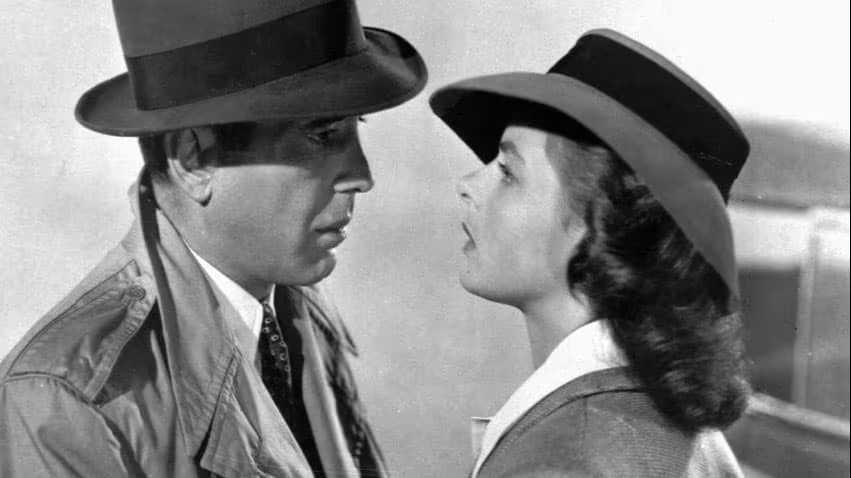
Even though most of his lines are relegated to a single exposition dump, Šerbedžija conveys a lot of potent regret and melancholy through his delivery alone, making me wish the movie was about him instead.  

Unfortunately, familiar action movie tropes eventually pile up and dilute whatever unique sense of identity Shooter had going for it.  Some of these trappings I’m willing to forgive, like all the bad guys not being able to hit the broad side of a barn in a firefight. But other cliches are pretty egregious and took me out of the movie. These moments include:

  • Wahlberg’s soldier buddy pulling out a photo of his wife moments before getting ravaged by bullets
  • Mara delicately dressing the wounds of a naked Wahlberg despite barely knowing him
  • One of the bad guys delivering the “we’re not so different, you and I” speech to Wahlberg as he’s being held at gunpoint
  • Wahlberg being way too cool to look back at the explosion he just set off

Many of these moments were old hat in the 1990s, so the fact that they were smuggled into a 2007 film (without anyone in production batting an eye) is very concerning.

And while Shooter is fairly generic overall, I will at least give the filmmakers credit for grounding it in the specific real-world politics of the time.

Instead of taking the coward’s way out and giving the bad guys vague motivations (as to not offend anyone), the screenwriters zero in on U.S. foreign policy being a pervasive antagonistic force.

Not only is the Abu Ghraib torture scandal mentioned by name, but most of the plot revolves around [SPOILERS] the American military covering up an African village massacre to further Big Oil business interests.

After watching my fair share of military propaganda for this blog, it was refreshing to see U.S. imperialism portrayed in a critical light, even if it is packaged in a movie where the hero solves all his problems with brute force.

In that sense, Shooter may resonate with more people in 2025 than it did in 2007, given that the current American government is explicitly threatening to annex places like Greenland, Panama, and even my home country of Canada. 

I’m not suggesting that a dumb action movie like Shooter will wake people up to this growing American hegemony or shake them from the kind of political apathy that allows evil to flourish.

But if someone receives a shock to the system by noticing how these goofy movie villains are being eclipsed by the sinister actions of real-world politicians, then maybe this film is a worthwhile watch after all.

Plus, did you see that scene where Wahlberg sniped three guys while standing up in a boat? That was sick!

Verdict:

6/10

Corner store companion:

Allen’s Cranberry Juice (because when it comes to resisting U.S. imperialism, buying a Canadian food product is on the same level as watching a vaguely anti-American film from 18 years ago)
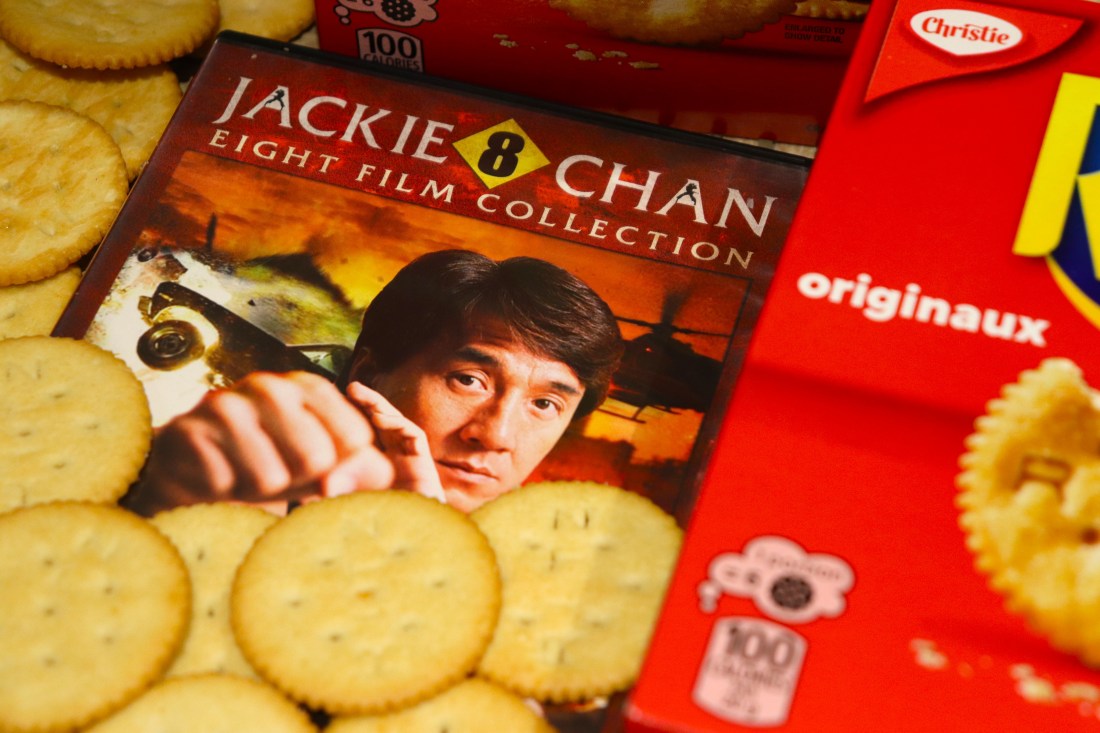
Fun facts:

Release date: March 23, 2007

Budget: $61 million

Box office: $95.7 million

-The character Bob Lee Swagger was originally created by author/film critic Stephen Hunter and first appeared in the 1993 novel Point of Impact. Hunter has written 12 books in the Bob Lee Swagger series, with the last story (Targeted) being published in 2022.

-The gun expert Wahlberg meets in the middle of the film is played by musician Levon Helm, who served as a drummer for The Band and was a 1994 inductee into the Rock and Roll Hall of Fame. Outside of his lengthy music career, Helm also appeared in films such as Coal Miner’s Daughter (1980) and The Right Stuff (1983).

-This film was later spun off into a TV series that ran for three seasons (2016-2018) on the USA Network. Ryan Phillippe took over the lead role from Wahlberg and the plot of the TV show revolved around the first three novels in the Bob Lee Swagger book series.

-Musical highlight: “Nasty Letter” by Otis Taylor (plays during the end credits)

The Man With The Golden Arm (1955) review-inject this into my veins

This year’s Oscar season birthed no end of controversy, with unearthed racist Tweets, accusations of unethical AI use, and concerns about absent intimacy coordinators clogging up the news cycle. While it’s fun to partake in all this chaos, it’s also important to remember that the Academy Awards do hold some cultural value beyond fueling online discourse.

Not only are the winners immortalized in film history, but even the nominees enjoy an elevated degree of prestige that prevents them from getting completely swallowed up by the relentless march of time.

Otto Preminger’s The Man With The Golden Arm (1955) certainly benefited from being in the Oscar race, with its nods for Best Actor (Frank Sinatra), Best Music, and Best Art Direction ensuring that it remained in the cultural conversation long after it left theatres.

Luckily, this film noir is the kind of movie that actually deserves a longer shelf life. It isn’t some flash-in-the-pan distraction that somehow snuck its way on the Oscar telecast through sleazy backdoor politicking. Preminger’s production is genuinely groundbreaking, being one of the first major Hollywood films to seriously grapple with the issue of hard drug addiction.

But beyond this historical distinction, The Man With The Golden Arm is just a damn good movie in its own right, with stellar performances, dynamic camera work, and a bombastic jazz score that cuts to the bone.

The film follows Frankie Machine (Sinatra), a recovering drug addict who vows to go on the straight and narrow after he’s released from prison. But finding honest work as a musician isn’t so easy for Frankie, especially after ghosts from his past lure him back into the world of illegal card dealing. Frankie also finds himself caught between the affections of two women, his wife Zosh (Eleanor Parker) and old flame Molly (Kim Novak), who represent his possible damnation to or salvation from the cycle of crime and addiction.

Sinatra is obviously the main draw here, coming in hot after winning a Best Supporting Actor Oscar for his role in From Here to Eternity (1953). While the crooner didn’t walk away with another golden statuette for headlining The Man With The Golden Arm, his work here is no less extraordinary.

Given the subject matter, it would have been easy to present a completely deranged character who rapidly shifts between big emotions to sell their less-than-ideal circumstances. But Sinatra usually plays it somewhere in the middle. He’s very restrained in the early parts of the movie, trying desperately to put his past behind him and carve out a new life through measured hope and optimism.

It’s only when the walls start to close in that he begins to lose his cool, resorting to a much broader acting style that some might consider “hammy” by today’s standards.

But considering the fact that he didn’t have a lot of influences to draw from (with the depiction of hard drug use being largely taboo in Hollywood at the time), Sinatra still presents a nuanced portrait of someone suffering through substance abuse, no doubt setting an entertainment industry standard for decades to come.

The rest of the cast put in similarly impressive work.

Even though they inhabit familiar film noir archetypes (the petty crook, the femme fatale, the heartless drug pusher, the hard-boiled cop, etc.), each actor gives their characters enough depth to keep things interesting.

This is especially true for Kim Novak, who could have easily come across as an evil seductress for preying on a married man. Instead, her concern and affection for Sinatra appears genuine and endearing, making her the most sympathetic player in the film’s overarching love triangle.

Another surprisingly charming character is Sparrow (Arnold Stang), a small-time hustler who is always trying to reel Sinatra into his latest scam. But despite Sparrow’s unsavory modus operandi, Stang manages to play him with a degree of kindness and good humour, so much so that he almost becomes the film’s Jiminy Cricket.

And as cliché as this might sound, one of the movie’s most interesting characters doesn’t actually appear on screen.

This is because the camerawork, led by cinematographer Sam Leavitt, is always engaging, constantly moving and finding interesting ways to frame the characters, illustrating their inner thoughts without strictly relying on dialogue.

One of the best examples of this takes place midway through the film, when Sinatra and Novak stroll by a department store window displaying a shiny new kitchen set. By capturing the character’s snappy back-and-forth dialogue within this backdrop, Leavitt offers the audience an aspirational glimpse into a possible domesticated future where the characters no longer have to scratch and claw to carve out a meager living.

It also doesn’t hurt that the movie captures these kinds of moments in mostly long, unbroken takes, which gives the actors lots of room to breathe and make the most of the script.

Said script, penned by Walter Newman and Lewis Meltzer, remains engaging throughout the movie’s runtime, mixing in insightful character moments with the kind of tough-guy dialogue one would expect from a film noir.  

The film’s Oscar-nominated score, composed by Elmer Bernstein, adds to this rhythm, serving as a kind of internal monologue for Sinatra’s state of mind. When those chaotic brass and percussion instruments pick up in speed and intensity, the actor doesn’t have to utter a word about suffering from withdrawal. The music does a lot of the heavy lifting.

Conversely, this emotionally-resonate score also kicks in when Sinatra is sharing a tender moment with Novak or Parker, except this time the composer relies on gentle woodwinds and strings to sell the fact that he is keeping his demons at bay.  

So just like the camerawork, the film’s music almost becomes another colourful member of the cast, or at least some kind of omniscient narrator that adds texture to the story.

That being said, the incorporation of music into the plot itself is a little half-hearted. While Sinatra’s main goal throughout the narrative is to become a professional drummer, his actual talent with the instrument is mostly talked about and only briefly shown. Plus, the big studio audition that the movie’s been building up to is over far too quickly, which slightly blunts the impact of Frankie’s downward spiral.

And while the movie usually does a good job of balancing its goofier elements with hard-hitting drama, that formula can get thrown out of whack sometimes.

Outside of a couple hokey speeches about drug addiction, which wouldn’t be out of place in a 1990s after-school special, the ending leaves a little to be desired.

Without getting into spoilers, one character exits the movie in a very silly fashion right before the credits roll, which caps off the film on a slightly sour note.

But those are just small quibbles, to be sure, and they don’t take away from The Man With The Golden Arm being the real deal.

Anyone who enjoys the look and feel of movies from that era of Hollywood can find it in spades with this production, with plenty of talented people working in front of and behind the camera.

And while it didn’t walk away with any golden statuettes at the 1956 Oscars, the film did legitimately push boundaries by allowing different kinds of stories (in this case, hard drug addiction) to appear on the big screen.

Because of the film’s controversial subject matter, the Production Code Administration (enforcers of the conservative Hays Code) refused to give it a seal of approval, thereby limiting its distribution in North America.

But after the movie garnered a lot of buzz without this seal, the Motion Picture Association of America eventually pressured the PCA to revise its code and allow drug addiction to be allowed in the movies.

And honestly, busting up obtuse censorship guidelines might be a better legacy to leave behind over winning big at the Academy Awards, especially given the tired discourse that plays out every time a movie brings home an Oscar.   

Verdict:

9/10

Corner store companion:

Golden Oreos (because they’re delicious and a lot less addictive than heroin)

Fun facts:

–Release date: December 15, 1955

–Budget: $1 million

–Box office: $4.3 million

–The Man With The Golden Arm finally received its PCA production code in 1961, six years after the film’s initial release. The PCA and the Hays Code were discarded in 1968 and were replaced by the modern MPAA rating system that same year.

–The Man With The Golden Arm was inducted into the United States’ National Film Registry in 2020 for being “culturally, historically or aesthetically significant.” It was added alongside classic films such as The Blues Brothers (1980), A Clockwork Orange (1971), The Dark Knight (2008), and Grease (1978).

-Actor Arnold Stang (who plays Sparrow) is probably best known for voicing the Hanna-Barbera cartoon character Top Cat for several decades.

–The Man With The Golden Arm is currently in the public domain and can be watched in its entirety on YouTube. Please watch using the provided link below and don’t bother with the official YouTube upload (since it’s been colourized and looks awful).